

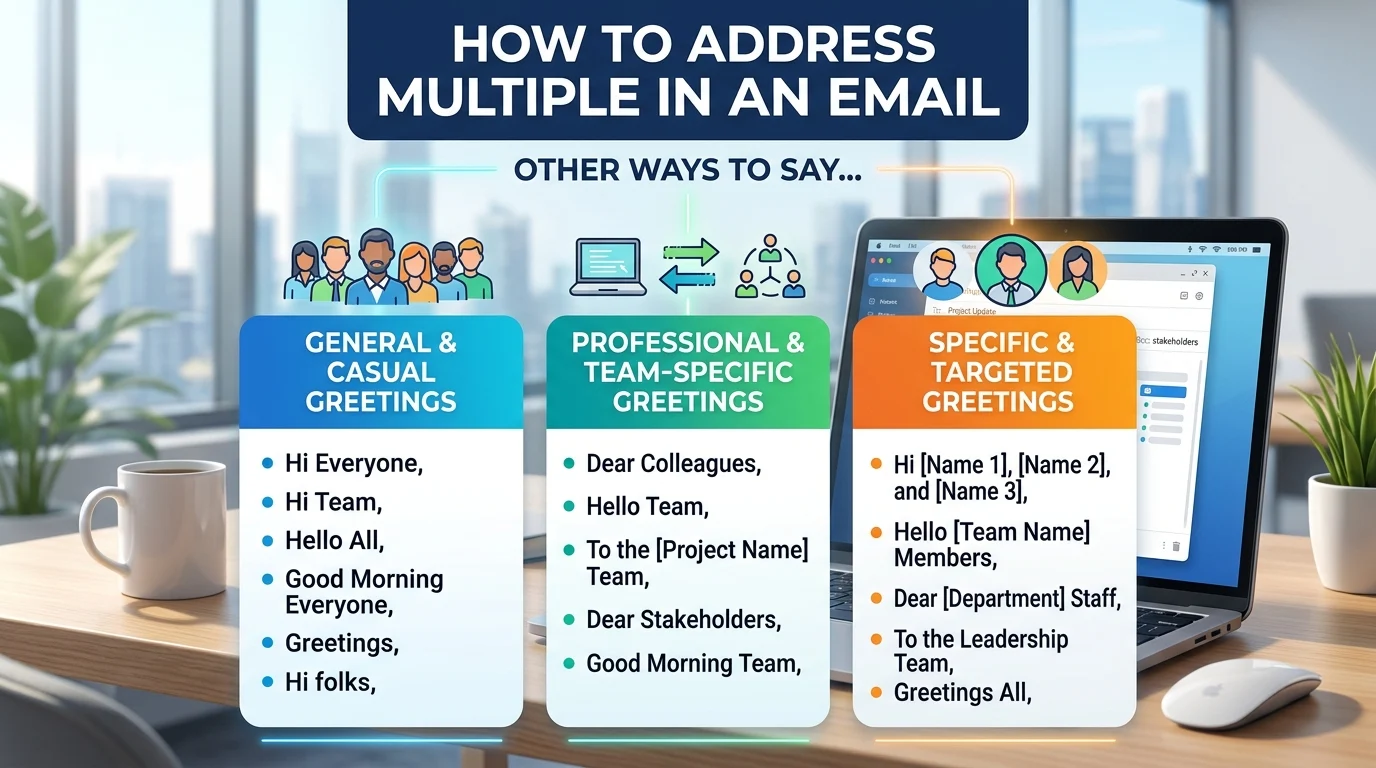
Knowing other ways to address multiple people in an email is an essential communication skill in today’s professional world. Whether you’re writing to coworkers, managers, clients, students, project teams, or business partners, choosing the right greeting helps create a positive first impression. Many people use the same opening repeatedly, such as “Dear All” or “Hi Everyone.” While these greetings are acceptable, learning other ways to address multiple people in an email can make your communication sound more polished, engaging, and professional.
- What Does "Address Multiple People in an Email" Mean?
- Grammar Form
- Student-Friendly Definition
- Example Sentences
- When to Use Other Ways to Address Multiple People in an Email
- Spoken English
- Business English
- Emails and Messages
- Academic Communication
- Professional Meetings
- Is It Professional to Use Other Ways to Address Multiple People in an Email?
- Formal Greetings
- Professional Greetings
- Friendly Greetings
- Workplace Tip
- Pros and Cons of Using Group Email Greetings
- ✔ Pros
- ✘ Cons
- Quick Alternatives List
- Dear Team
- Meaning
- Explanation
- Grammar Note
- Example Sentence
- Best Use
- Worst Use
- Tone
- Level
- Similarity Score
- Replaceability Tip
- Dear Colleagues
- Meaning
- Explanation
- Example Sentence
- Best Use
- Worst Use
- Tone
- Level
- Similarity Score
- Hello Everyone
- Meaning
- Explanation
- Example Sentence
- Best Use
- Tone
- Level
- Similarity Score
- Dear All
- Meaning
- Explanation
- Example Sentence
- Tone
- Similarity Score
- Greetings Team
- Meaning
- Explanation
- Example Sentence
- Tone
- Similarity Score
- Hello Team
- Meaning
- Explanation
- Example Sentence
- Tone
- Similarity Score
- Greetings Everyone
- Meaning
- Explanation
- Example Sentence
- Tone
- Similarity Score
- Dear Team Members
- Meaning
- Example Sentence
- Tone
- Similarity Score
- Good Morning Everyone
- Meaning
- Example Sentence
- Tone
- Similarity Score
- Good Afternoon Everyone
- Meaning
- Example Sentence
- Tone
- Similarity Score
- Dear Participants
- Meaning
- Example Sentence
- Tone
- Similarity Score
- Dear Partners
- Meaning
- Example Sentence
- Tone
- Similarity Score
- Dear Committee Members
- Meaning
- Example Sentence
- Tone
- Similarity Score
- Good Day Everyone
- Meaning
- Example Sentence
- Tone
- Similarity Score
- Valued Team Members
- Meaning
- Example Sentence
- Tone
- Similarity Score
- Mini Dialogue Examples
- Formal Dialogue
- Informal Dialogue
- Business Email Example
- Mistakes to Avoid
- Cultural and Tone Tips
- US English
- UK English
- Corporate Communication
- Startup Culture
- Comparison Table
- Frequently Asked Questions
- Is "Dear All" professional?
- What is the best professional greeting?
- Is "Hi Everyone" professional?
- Should I use "Hey Guys"?
- What is the most formal option?
- What should beginners use?
- Conclusion
Using other ways to address multiple people in an email also helps you adapt your tone to different audiences. Some greetings are perfect for formal corporate communication, while others work better for friendly team discussions. By expanding your vocabulary and learning other ways to address multiple people in an email, you can improve workplace communication, strengthen relationships, and make your emails more effective.
For example:
Formal: Dear Colleagues,
Informal: Hi Everyone,
Both are useful other ways to address multiple people in an email, but each creates a different tone.
What Does “Address Multiple People in an Email” Mean?
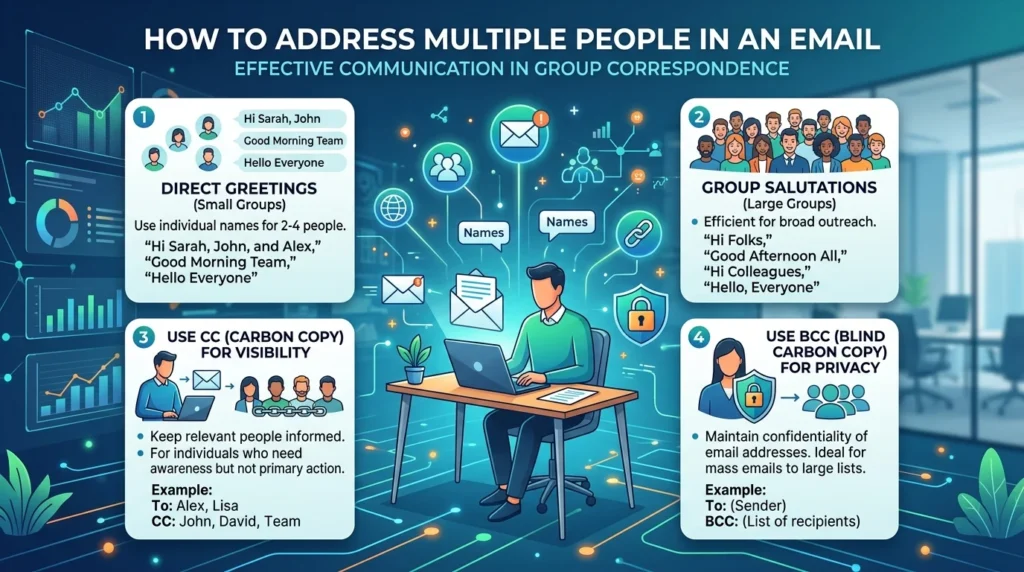
To address multiple people in an email means using a greeting or salutation that is directed toward more than one recipient. Understanding other ways to address multiple people in an email allows you to communicate respectfully and professionally with groups.
When professionals search for other ways to address multiple people in an email, they usually want alternatives that sound modern, inclusive, professional, and audience-appropriate.
Grammar Form
Email greeting or salutation phrase.
Student-Friendly Definition
A greeting used when sending an email to more than one person.
Example Sentences
- Dear Team,
- Hello Everyone,
- Greetings Colleagues,
When to Use Other Ways to Address Multiple People in an Email
Spoken English
Although greetings are primarily written, discussing other ways to address multiple people in an email can help improve communication skills.
Business English
Professionals frequently use other ways to address multiple people in an email when contacting departments, teams, and stakeholders.
Emails and Messages
This is the most common situation where other ways to address multiple people in an email are needed.
Academic Communication
Teachers, students, and researchers often use other ways to address multiple people in an email when communicating with groups.
Professional Meetings
Follow-up emails often require professional group greetings.
Is It Professional to Use Other Ways to Address Multiple People in an Email?
Yes. Selecting the right greeting demonstrates professionalism and respect.
Formal Greetings
- Dear Colleagues
- Dear Committee Members
- Dear Team Members
Professional Greetings
- Dear Team
- Greetings Team
- Hello Team
Friendly Greetings
- Hi Everyone
- Hello Everyone
- Good Morning Everyone
Workplace Tip
When choosing other ways to address multiple people in an email, avoid overly casual greetings such as “Hey Guys” in formal business settings.
Pros and Cons of Using Group Email Greetings
✔ Pros
- Creates a professional first impression
- Includes all recipients
- Saves time
- Improves communication
- Suitable for workplace emails
✘ Cons
- Can sound generic
- Some greetings feel outdated
- Not every greeting fits every audience
- Informal options may seem unprofessional
Quick Alternatives List
- Dear Team
- Dear Colleagues
- Dear All
- Hello Everyone
- Hi Everyone
- Hello Team
- Greetings Team
- Greetings Everyone
- Dear Team Members
- Good Morning Everyone
- Good Afternoon Everyone
- Dear Participants
- Dear Partners
- Dear Committee Members
- Good Day Everyone
- Hello All
- Esteemed Colleagues
- Valued Team Members
- Dear Friends
- Team
Dear Team
Meaning
A professional greeting used for coworkers.
Explanation
One of the most common other ways to address multiple people in an email in modern workplaces.
Grammar Note
Professional email salutation.
Example Sentence
Dear Team,
Thank you for your continued support.
Best Use
Workplace communication.
Worst Use
Formal legal correspondence.
Tone
Professional.
Level
Beginner.
Similarity Score
10/10
Replaceability Tip
Use it when emailing coworkers or project teams.
Dear Colleagues
Meaning
A respectful greeting for professional peers.
Explanation
Among the most professional other ways to address multiple people in an email.
Example Sentence
Dear Colleagues,
I appreciate your contributions.
Best Use
Corporate communication.
Worst Use
Casual personal emails.
Tone
Formal Professional.
Level
Intermediate.
Similarity Score
10/10
Hello Everyone
Meaning
A friendly greeting for groups.
Explanation
One of the most versatile other ways to address multiple people in an email.
Example Sentence
Hello Everyone,
I hope you’re doing well.
Best Use
General workplace communication.
Tone
Friendly Professional.
Level
Beginner.
Similarity Score
9/10
Dear All
Meaning
A traditional group greeting.
Explanation
One of the oldest other ways to address multiple people in an email and still widely used.
Example Sentence
Dear All,
Please review the attached document.
Tone
Formal.
Similarity Score
10/10
Greetings Team
Meaning
A welcoming team-focused greeting.
Explanation
A modern option among other ways to address multiple people in an email.
Example Sentence
Greetings Team,
Let’s discuss our goals for next quarter.
Tone
Professional.
Similarity Score
8/10
Hello Team
Meaning
A friendly greeting for coworkers.
Explanation
Common in internal communication.
Example Sentence
Hello Team,
Thank you for your efforts.
Tone
Professional Friendly.
Similarity Score
9/10
Greetings Everyone
Meaning
A warm greeting for multiple recipients.
Explanation
An effective choice among other ways to address multiple people in an email.
Example Sentence
Greetings Everyone,
I would like to share an important update.
Tone
Professional.
Similarity Score
8/10
Dear Team Members
Meaning
A formal greeting for a specific group.
Example Sentence
Dear Team Members,
Thank you for attending the meeting.
Tone
Formal.
Similarity Score
9/10
Good Morning Everyone
Meaning
A time-specific greeting.
Example Sentence
Good Morning Everyone,
I hope your day is off to a great start.
Tone
Professional.
Similarity Score
8/10
Good Afternoon Everyone
Meaning
An afternoon greeting.
Example Sentence
Good Afternoon Everyone,
Thank you for joining today’s session.
Tone
Professional.
Similarity Score
8/10
Dear Participants
Meaning
Used for event attendees.
Example Sentence
Dear Participants,
Thank you for registering.
Tone
Professional.
Similarity Score
7/10
Dear Partners
Meaning
Used for business collaborators.
Example Sentence
Dear Partners,
We appreciate your partnership.
Tone
Professional.
Similarity Score
7/10
Dear Committee Members
Meaning
Used for committees and boards.
Example Sentence
Dear Committee Members,
Please review the proposal.
Tone
Formal.
Similarity Score
8/10
Good Day Everyone
Meaning
A polite all-purpose greeting.
Example Sentence
Good Day Everyone,
Thank you for your participation.
Tone
Professional.
Similarity Score
8/10
Valued Team Members
Meaning
A respectful greeting showing appreciation.
Example Sentence
Valued Team Members,
Your hard work is appreciated.
Tone
Professional.
Similarity Score
7/10
Mini Dialogue Examples
Formal Dialogue
Manager:
How should I begin this email?
Director:
Use one of the professional other ways to address multiple people in an email, such as “Dear Colleagues.”
Informal Dialogue
Employee:
Should I write “Hi Everyone”?
Coworker:
Yes, it’s one of the friendliest other ways to address multiple people in an email.
Business Email Example
Subject: Quarterly Update
Dear Team,
I would like to provide an update regarding our quarterly goals and achievements. Thank you for your continued dedication and support.
Best regards,
Sarah
Mistakes to Avoid
- Using “Hey Guys” in formal communication.
- Choosing overly casual greetings for executives.
- Ignoring company culture.
- Mixing formal and informal language.
- Using outdated greetings unnecessarily.
- Forgetting to consider your audience.
- Overcomplicating simple greetings.
Cultural and Tone Tips
US English
“Hello Everyone” and “Hi Team” are common.
UK English
“Dear All” remains highly accepted.
Corporate Communication
“Dear Team” and “Dear Colleagues” are often preferred.
Startup Culture
“Hello Team” and “Greetings Everyone” are popular.
Comparison Table
| Phrase | Tone | Best Context | Professional Level | Example |
|---|---|---|---|---|
| Dear Team | Professional | Workplace | High | Dear Team, |
| Dear Colleagues | Formal | Corporate | High | Dear Colleagues, |
| Hello Everyone | Friendly Professional | General | High | Hello Everyone, |
| Dear All | Formal | Business | High | Dear All, |
| Greetings Team | Professional | Announcements | High | Greetings Team, |
| Hi Everyone | Friendly | Internal Teams | Medium | Hi Everyone, |
| Good Morning Everyone | Professional | Daily Updates | High | Good Morning Everyone, |
Frequently Asked Questions
Is “Dear All” professional?
Yes, it is one of the most widely accepted other ways to address multiple people in an email.
What is the best professional greeting?
“Dear Team” is among the best other ways to address multiple people in an email.
Is “Hi Everyone” professional?
Yes, especially for internal communication.
Should I use “Hey Guys”?
Generally no, especially in formal settings.
What is the most formal option?
“Dear Colleagues” and “Dear Committee Members.”
What should beginners use?
“Hello Everyone” is one of the simplest other ways to address multiple people in an email.
Conclusion
Learning other ways to address multiple people in an email can significantly improve your professional communication. While common greetings such as “Dear All” and “Hi Everyone” remain useful, exploring other ways to address multiple people in an email helps you choose the perfect tone for every audience. Whether you select “Dear Team,” “Dear Colleagues,” “Hello Everyone,” or “Greetings Team,” using the right greeting creates a stronger first impression and enhances workplace communication.