
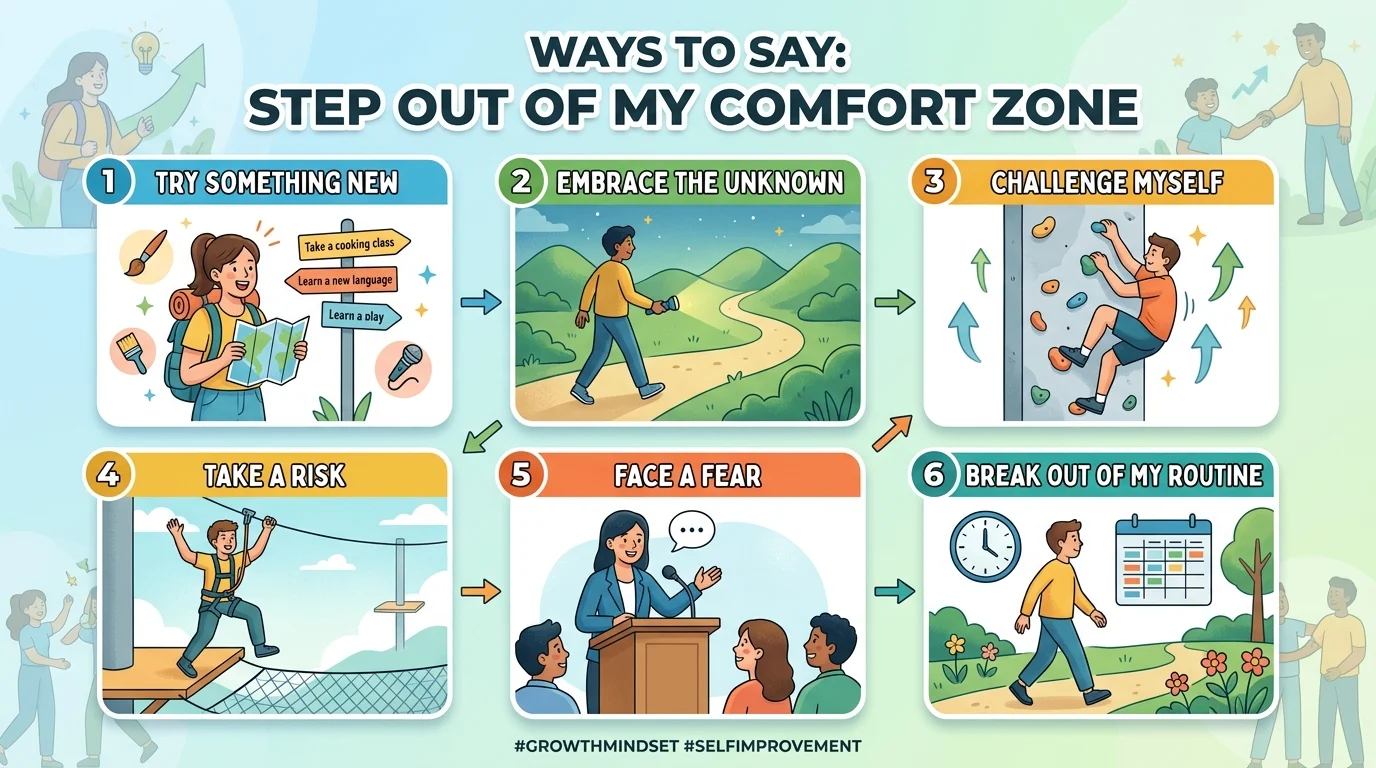
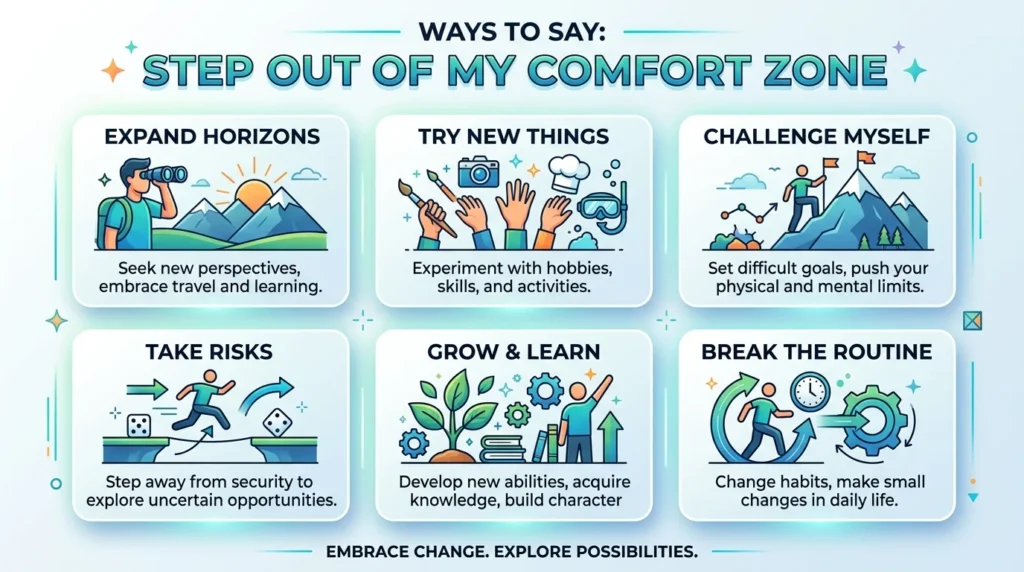
The phrase “ways to say step out of my comfort zone” is commonly used when talking about personal growth, self-improvement, career development, and new experiences. It describes the act of doing something unfamiliar, challenging, or slightly uncomfortable in order to learn, grow, or achieve a goal. Whether you’re discussing a new job opportunity, public speaking, travel experiences, leadership roles, or personal development, this phrase is widely recognized and understood.
- What Does “Step Out of My Comfort Zone” Mean?
- Grammar Form
- Simple Definition
- Similar Expressions
- Opposite Expressions
- Example Sentences
- When to Use “Step Out of My Comfort Zone”
- Spoken English
- Business English
- Job Interviews
- Academic Writing
- Professional Meetings
- Social Media
- Is “Step Out of My Comfort Zone” Professional?
- Formal Tone
- Professional Tone
- Motivational Tone
- Informal Tone
- Workplace Tip
- Pros and Cons of Using “Step Out of My Comfort Zone”
- ✔ Pros
- ✘ Cons
- Quick Alternatives List
- Challenge Myself
- Meaning
- Explanation
- Grammar Note
- Example Sentence
- Best Use
- Worst Use
- Tone
- Level
- Similarity Score
- Replaceability Tip
- Push My Boundaries
- Meaning
- Explanation
- Example Sentence
- Best Use
- Tone
- Similarity Score
- Try Something New
- Meaning
- Explanation
- Example Sentence
- Tone
- Similarity Score
- Take on a New Challenge
- Meaning
- Example Sentence
- Tone
- Similarity Score
- Expand My Horizons
- Meaning
- Example Sentence
- Tone
- Similarity Score
- Stretch Myself
- Meaning
- Example Sentence
- Tone
- Similarity Score
- Explore Unfamiliar Territory
- Meaning
- Example Sentence
- Tone
- Similarity Score
- Embrace New Experiences
- Meaning
- Example Sentence
- Tone
- Similarity Score
- Venture Beyond the Familiar
- Meaning
- Example Sentence
- Tone
- Similarity Score
- Break Out of My Routine
- Meaning
- Example Sentence
- Tone
- Similarity Score
- Take a Leap of Faith
- Meaning
- Example Sentence
- Tone
- Similarity Score
- Test My Limits
- Meaning
- Example Sentence
- Tone
- Similarity Score
- Push Past My Fears
- Meaning
- Example Sentence
- Tone
- Similarity Score
- Broaden My Perspective
- Meaning
- Example Sentence
- Tone
- Similarity Score
- Face New Challenges
- Meaning
- Example Sentence
- Tone
- Similarity Score
- Mini Dialogue Examples
- Formal Dialogue
- Informal Dialogue
- Workplace Example
- Common Mistakes to Avoid
- Cultural and Tone Tips
- US English
- UK English
- Workplace Communication
- Interviews
- Comparison Table
- Frequently Asked Questions
- Is “step out of my comfort zone” professional?
- Is it appropriate for resumes?
- What is the most professional alternative?
- What is the most motivational alternative?
- What is the simplest alternative?
- What should beginners use?
- Conclusion
However, using the same expression repeatedly can make your writing and speech sound repetitive. That is why many people search for other ways to say step out of my comfort zone. Learning alternative expressions helps you communicate more effectively, sound more professional, and add variety to your language.
Understanding other ways to say step out of my comfort zone can improve your communication skills in interviews, resumes, workplace discussions, motivational writing, academic essays, and everyday conversations. The right phrase can make your message sound more confident, inspiring, and impactful.
For example:
Professional: I wanted to challenge myself professionally.
Casual: I decided to try something new.
Both expressions communicate the idea of growth, but they create different tones.
What Does “Step Out of My Comfort Zone” Mean?
The phrase ways to say step out of my comfort zone means to do something that feels unfamiliar, challenging, or uncomfortable in order to grow, learn, or gain new experiences.
People often use this phrase when:
- Starting a new job
- Learning a new skill
- Public speaking
- Traveling alone
- Taking leadership roles
- Facing personal fears
When people search for other ways to say step out of my comfort zone, they usually want alternatives that sound more professional, motivational, or natural.
Grammar Form
The phrase is an idiomatic expression.
Simple Definition
It means:
“To do something challenging or unfamiliar.”
Similar Expressions
- Challenge myself
- Try something new
- Push my limits
- Embrace new experiences
- Take a risk
Opposite Expressions
- Stay in my comfort zone
- Avoid challenges
- Play it safe
- Stick to what I know
Example Sentences
- I decided to step out of my comfort zone and apply for a leadership position.
- Traveling alone helped me step out of my comfort zone.
When to Use “Step Out of My Comfort Zone”
Spoken English
Very common in everyday conversations.
Example:
“I wanted to step out of my comfort zone and learn a new language.”
Business English
Useful when discussing career growth.ways to say step out of my comfort zone.
Example:
“I accepted the project to step out of my comfort zone.”
Job Interviews
Frequently used to describe personal development.
Example:
“I wanted opportunities that would help me step out of my comfort zone.”
Academic Writing
Can be used in personal essays.ways to say step out of my comfort zone.
Example:
“Studying abroad allowed me to step out of my comfort zone.”
Professional Meetings
Useful when discussing learning opportunities.
Example:
“This role encouraged me to step out of my comfort zone.”
Social Media
Popular in motivational content.
Example:
“Growth begins when you step out of your comfort zone.”
Is “Step Out of My Comfort Zone” Professional?
Yes. It is generally professional and acceptable in workplace communication.
Formal Tone
Moderately formal.
Professional Tone
Common in interviews and career discussions.
Motivational Tone
Frequently used in self-development contexts.
Informal Tone
Also works naturally in casual conversations.
Workplace Tip
Among all other ways to say step out of my comfort zone, this phrase remains one of the most widely accepted in professional development discussions.ways to say step out of my comfort zone.
Pros and Cons of Using “Step Out of My Comfort Zone”
✔ Pros
- Easy to understand
- Motivational
- Positive
- Commonly used
- Suitable for interviews
- Encourages growth
✘ Cons
- Can feel overused
- Sometimes sounds cliché
- Less impactful if repeated frequently
- May lack originality
Quick Alternatives List
If you need other ways to say step out of my comfort zone quickly, try these:
- Challenge myself
- Push my boundaries
- Try something new
- Take on a new challenge
- Expand my horizons
- Stretch myself
- Explore unfamiliar territory
- Embrace new experiences
- Venture beyond the familiar
- Break out of my routine
- Take a leap of faith
- Test my limits
- Grow through discomfort
- Push past my fears
- Leave my comfort zone
- Take calculated risks
- Develop new skills
- Broaden my perspective
- Face new challenges
- Go beyond what feels comfortable
Challenge Myself
Meaning
To deliberately take on difficult tasks.
Explanation
One of the strongest alternatives toways to say step out of my comfort zone.
Grammar Note
Verb phrase.
Example Sentence
I wanted to challenge myself by learning public speaking.
Best Use
Interviews, resumes, workplace discussions.
Worst Use
Situations that require a casual tone.
Tone
Professional.
Level
Beginner.
Similarity Score
10/10
Replaceability Tip
Perfect for career development conversations.ways to say step out of my comfort zone.
Push My Boundaries
Meaning
To go beyond personal limits.
Explanation
Emphasizes growth and achievement.
Example Sentence
The project allowed me to push my boundaries.ways to say step out of my comfort zone.
Best Use
Motivational writing and interviews.
Tone
Inspirational.
Similarity Score
9/10
Try Something New
Meaning
To experience something unfamiliar.
Explanation
A simple and beginner-friendly alternative.ways to say step out of my comfort zone.
Example Sentence
I wanted to try something new this year.
Tone
Friendly.
Similarity Score
8/10
Take on a New Challenge
Meaning
To accept a difficult opportunity.
Example Sentence
I decided to take on a new challenge at work.ways to say step out of my comfort zone.
Tone
Professional.
Similarity Score
9/10
Expand My Horizons
Meaning
To gain new experiences and perspectives.
Example Sentence
Travel helped me expand my horizons.
Tone
Professional.
Similarity Score
8/10
Stretch Myself
Meaning
To do more than usual.
Example Sentence
I wanted to stretch myself professionally.
Tone
Professional.
Similarity Score
8/10
Explore Unfamiliar Territory
Meaning
To enter new situations.
Example Sentence
The role allowed me to explore unfamiliar territory.
Tone
Professional.
Similarity Score
8/10
Embrace New Experiences
Meaning
To welcome unfamiliar opportunities.
Example Sentence
I wanted to embrace new experiences.
Tone
Positive.
Similarity Score
8/10
Venture Beyond the Familiar
Meaning
To move beyond known situations.
Example Sentence
I decided to venture beyond the familiar.
Tone
Advanced.
Similarity Score
8/10
Break Out of My Routine
Meaning
To stop doing the same things repeatedly.
Example Sentence
I joined the class to break out of my routine.
Tone
Friendly.
Similarity Score
7/10
Take a Leap of Faith
Meaning
To take a risk despite uncertainty.
Example Sentence
Starting my business was a leap of faith.
Tone
Inspirational.
Similarity Score
8/10
Test My Limits
Meaning
To discover what you are capable of.
Example Sentence
I wanted to test my limits through competition.
Tone
Motivational.
Similarity Score
8/10
Push Past My Fears
Meaning
To overcome fear.
Example Sentence
Public speaking helped me push past my fears.
Tone
Inspirational.
Similarity Score
9/10
Broaden My Perspective
Meaning
To gain a wider understanding.
Example Sentence
Living abroad broadened my perspective.
Tone
Professional.
Similarity Score
7/10
Face New Challenges
Meaning
To deal with unfamiliar situations.
Example Sentence
I was eager to face new challenges.
Tone
Professional.
Similarity Score
9/10
Mini Dialogue Examples
Formal Dialogue
Interviewer:
Why did you apply for this position?
Candidate:
I wanted an opportunity to challenge myself and grow professionally.
Informal Dialogue
Friend:
Why did you join the dance class?
Friend:
I wanted to try something new and get out of my routine.
Workplace Example
Manager:
What motivated you to lead the project?
Employee:
I wanted to take on a new challenge and develop my leadership skills.
Common Mistakes to Avoid
- Overusing the phrase in every conversation.
- Using it without explaining the challenge.
- Sounding cliché in professional writing.
- Choosing informal alternatives for formal interviews.
- Mixing motivational language with negative statements.
- Using vague examples.
- Failing to show actual growth.
Cultural and Tone Tips
US English
The phrase is common in career and self-development discussions.
UK English
Professional alternatives such as “challenge myself” are often preferred.
Workplace Communication
Specific examples are usually more effective than generic phrases.
Interviews
Employers appreciate alternatives that demonstrate measurable growth.
Comparison Table
| Phrase | Tone | Best Context | Professional Level | Example |
|---|---|---|---|---|
| Challenge myself | Professional | Interviews | High | I wanted to challenge myself. |
| Push my boundaries | Inspirational | Personal growth | High | I pushed my boundaries. |
| Take on a new challenge | Professional | Career discussions | High | I took on a new challenge. |
| Expand my horizons | Professional | Education | High | I wanted to expand my horizons. |
| Try something new | Friendly | Casual conversations | Medium | I wanted to try something new. |
| Face new challenges | Professional | Workplace | High | I was eager to face new challenges. |
| Push past my fears | Motivational | Personal development | Medium | I pushed past my fears. |
Frequently Asked Questions
Is “step out of my comfort zone” professional?
Yes. It is commonly used in interviews and workplace discussions.
Is it appropriate for resumes?
Yes, but more specific alternatives are often stronger.
What is the most professional alternative?
Challenge myself.
What is the most motivational alternative?
Push my boundaries.
What is the simplest alternative?
Try something new.
What should beginners use?
Challenge myself or try something new.
Conclusion
Learning other ways to say step out of my comfort zone can help you express personal growth, ambition, and resilience more effectively. While the original phrase remains popular and useful, using alternative expressions allows you to sound more professional, engaging, and specific. Whether you are preparing for an interview, writing a resume, discussing career goals, or sharing personal experiences, these alternatives can help you communicate your willingness to grow and embrace new opportunities with confidence.