
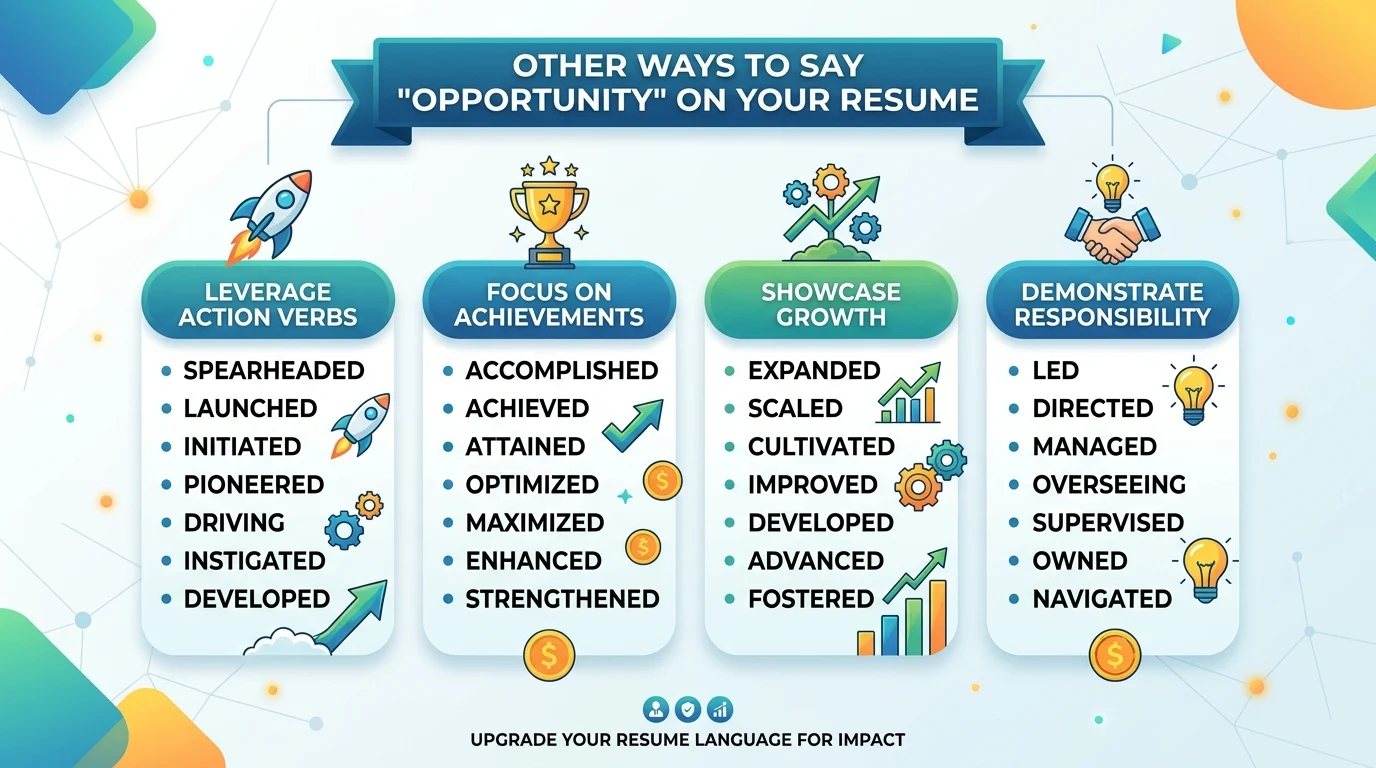
Other ways to say opportunity on your resume can help make your job application stronger, more professional, and more persuasive. The word other ways to say opportunity on your resume is commonly used in resumes, cover letters, LinkedIn profiles, and job applications. While it is a useful word, using it too often can make your resume sound repetitive and less impactful.
- Grammar Form
- Student-Friendly Definition
- Example Sentences
- Professional Summaries
- Work Experience Sections
- Cover Letters
- LinkedIn Profiles
- Career Objectives
- Interview Preparation
- Formal
- Professional
- Achievement-Oriented
- Resume Tip
- ✔ Pros
- ✘ Cons
- Meaning
- Explanation
- Example Sentence
- Best Use
- Tone
- Similarity Score
- Meaning
- Explanation
- Example Sentence
- Best Use
- Tone
- Similarity Score
- Meaning
- Explanation
- Example Sentence
- Best Use
- Tone
- Similarity Score
- Meaning
- Explanation
- Example Sentence
- Best Use
- Tone
- Similarity Score
- Meaning
- Explanation
- Example Sentence
- Best Use
- Tone
- Similarity Score
- Meaning
- Explanation
- Example Sentence
- Best Use
- Tone
- Similarity Score
- Meaning
- Explanation
- Example Sentence
- Best Use
- Tone
- Similarity Score
- Meaning
- Explanation
- Example Sentence
- Best Use
- Tone
- Similarity Score
- Meaning
- Explanation
- Example Sentence
- Best Use
- Tone
- Similarity Score
- Meaning
- Explanation
- Example Sentence
- Best Use
- Tone
- Similarity Score
- Formal Dialogue
- Informal Dialogue
- Cover Letter Example
- US English
- UK English
- Corporate Resumes
- Executive Resumes
- Is “opportunity” good on a resume?
- What is the strongest replacement?
- What is best for achievements?
- What is the most professional alternative?
- Can I remove the word completely?
- What should beginners use?
Many job seekers search for other ways to say opportunity on your resume because recruiters and hiring managers often review hundreds of applications. Using stronger and more specific language can help your resume stand out. The best alternative depends on the context. Sometimes you may want to emphasize growth, responsibility, achievement, experience, or advancement rather than simply using the word other ways to say opportunity on your resume.
Learning other ways to say opportunity on your resume can improve your professional writing and help you present your accomplishments more effectively. Whether you are creating your first resume or updating an executive-level CV, the right word choice can make a significant difference.
For example:
Basic: I had the opportunity to lead a team.
Stronger: I was entrusted to lead a team.
The second example sounds more confident and achievement-focused.
What Does “Opportunity” Mean on a Resume?
On a resume, opportunity usually refers to a chance to learn, grow, contribute,other ways to say opportunity on your resume, lead, develop skills, or advance professionally.
People often look for other ways to say opportunity on your resume because they want language that sounds more active and accomplishment-oriented.
Grammar Form
Noun.
Student-Friendly Definition
A chance to do something, learn something,other ways to say opportunity on your resume, or achieve something.
Example Sentences
- I had the opportunity to manage client accounts.
- This role provided an opportunity to improve leadership skills.
When to Use “Opportunity” on a Resume
Professional Summaries
Useful when discussing career growth.
Work Experience Sections
Can describe responsibilities and achievements.
Cover Letters
Frequently used when discussing career goals.
LinkedIn Profiles
Helpful when describing professional development.
Career Objectives
Can highlight future ambitions.
Interview Preparation
Useful when discussing previous roles.
Is “Opportunity” Professional?
Yes. The word is professional and widely accepted.
Formal
- Advancement
- Prospect
Professional
- Responsibility
- Assignment
Achievement-Oriented
- Leadership Role
- Initiative
Resume Tip
Instead of repeatedly using opportunity, choose alternatives that emphasize action, achievement, or responsibility.
Pros and Cons of Using “Opportunity”
✔ Pros
- Professional
- Easy to understand
- Common in resumes
- Flexible across industries
- Positive meaning
✘ Cons
- Frequently overused
- Can sound passive
- Less impactful than stronger alternatives
- May weaken achievement statements
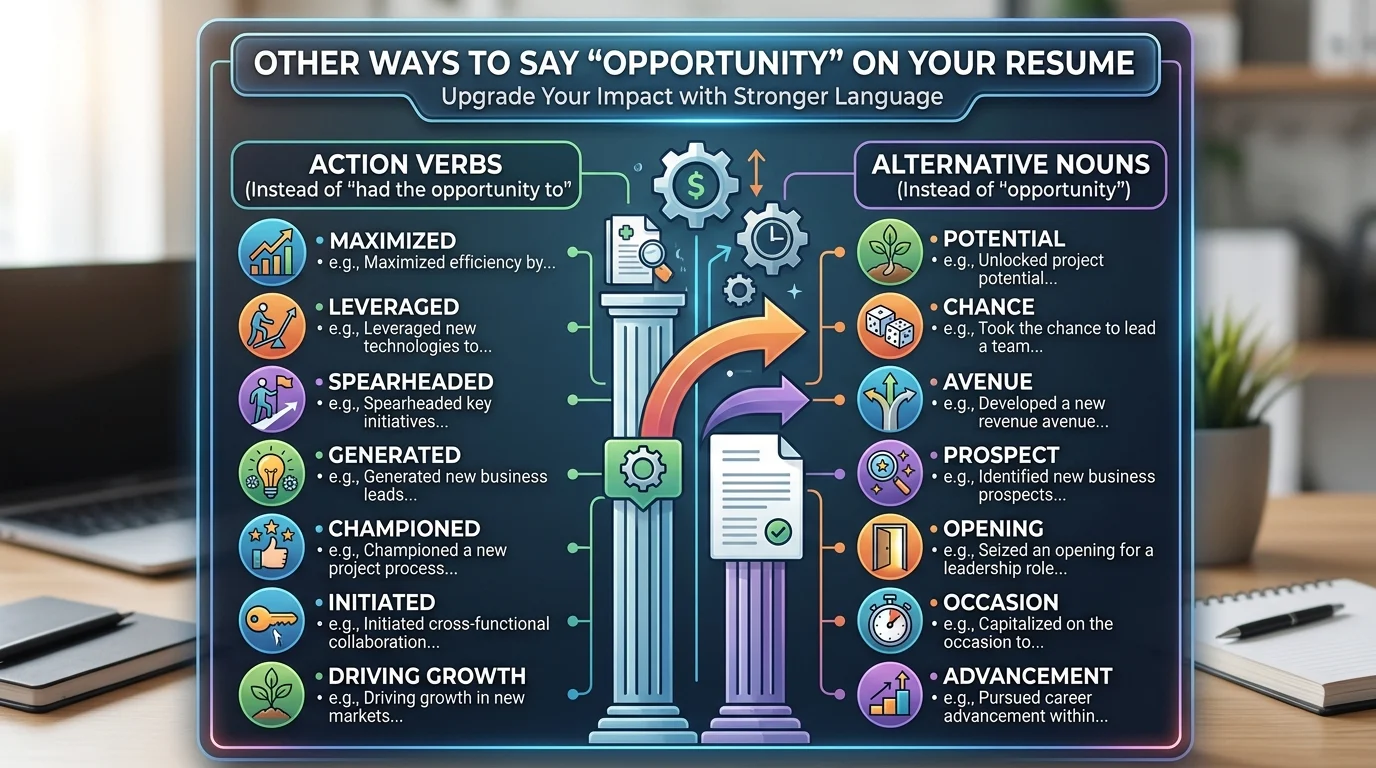
Quick Alternatives List
- Responsibility
- Assignment
- Role
- Position
- Initiative
- Prospect
- Challenge
- Advancement
- Experience
- Leadership Role
- Privilege
- Platform
- Opening
- Project
- Engagement
- Contribution
- Endeavor
- Task
- Development Opportunity
- Growth Experience
Responsibility
Meaning
A duty or task assigned to you.
Explanation
One of the strongest other ways to say opportunity on your resume because it highlights trust and accountability.
Example Sentence
I was given the responsibility of leading a five-person team.
Best Use
Work experience sections.
Tone
Professional.
Similarity Score
9/10
Assignment
Meaning
A specific task or project.
Explanation
Focuses on work performed rather than potential.
Example Sentence
I completed a high-priority assignment for senior management.
Best Use
Project descriptions.
Tone
Professional.
Similarity Score
8/10
Initiative
Meaning
A project or action designed to achieve a goal.
Explanation
One of the most effective other ways to say opportunity on your resume when discussing accomplishments.
Example Sentence
I led an initiative that improved efficiency by 20%.
Best Use
Achievement statements.
Tone
Professional.
Similarity Score
7/10
Advancement
Meaning
Progression in career or responsibilities.
Explanation
Excellent when discussing growth.
Example Sentence
The role provided advancement into leadership positions.
Best Use
Career summaries.
Tone
Professional.
Similarity Score
8/10
Leadership Role
Meaning
A position involving management or guidance.
Explanation
Highlights authority and responsibility.
Example Sentence
I accepted a leadership role overseeing multiple departments.
Best Use
Management resumes.
Tone
Professional.
Similarity Score
8/10
Challenge
Meaning
A demanding task or situation.
Explanation
Shows willingness to grow and solve problems.
Example Sentence
I embraced the challenge of launching a new product line.
Best Use
Achievement sections.
Tone
Professional.
Similarity Score
7/10
Experience
Meaning
Practical involvement or exposure.
Explanation
One of the safest other ways to say opportunity on your resume.
Example Sentence
The position provided valuable experience in project management.
Best Use
Professional summaries.
Tone
Professional.
Similarity Score
8/10
Platform
Meaning
A foundation for growth or contribution.
Explanation
Useful when discussing career development.
Example Sentence
The role served as a platform for leadership development.
Best Use
Cover letters.
Tone
Professional.
Similarity Score
7/10
Prospect
Meaning
A potential future possibility.
Explanation
A formal alternative often used in career discussions.
Example Sentence
The position offered strong prospects for advancement.
Best Use
Career planning.
Tone
Formal.
Similarity Score
8/10
Growth Experience
Meaning
An experience that promotes learning and development.
Explanation
A modern alternative emphasizing personal improvement.
Example Sentence
The project became a significant growth experience in my career.
Best Use
Professional summaries.
Tone
Professional.
Similarity Score
7/10
Mini Dialogue Examples
Formal Dialogue
Recruiter:
What did you gain from your previous role?
Candidate:
It provided valuable leadership experience and professional growth.
Informal Dialogue
Friend:
Why did you take that job?
Friend:
It was a great opportunity for career advancement.
Cover Letter Example
Dear Hiring Manager,
My previous position gave me the responsibility of managing cross-functional teams and leading strategic initiatives. These experiences strengthened my leadership and communication skills.
Sincerely,
John Smith
Common Mistakes to Avoid
- Repeating “opportunity” throughout the resume.
- Using vague descriptions.
- Focusing on chances instead of achievements.
- Using passive language.
- Ignoring measurable results.
- Overusing corporate jargon.
- Choosing weak action words.
Cultural & Tone Tips
US English
Achievement-focused language is highly valued.
UK English
Professional and concise wording is preferred.
Corporate Resumes
Specific accomplishments are stronger than generic references to opportunities.
Executive Resumes
Leadership-oriented alternatives create greater impact.
Comparison Table
| Phrase | Tone | Best Context | Professional Level | Example |
|---|---|---|---|---|
| Responsibility | Professional | Work Experience | High | Given responsibility for a team. |
| Assignment | Professional | Projects | High | Completed a strategic assignment. |
| Initiative | Professional | Achievements | High | Led an initiative. |
| Advancement | Professional | Career Growth | High | Opportunity for advancement. |
| Leadership Role | Professional | Management | Very High | Accepted a leadership role. |
| Experience | Professional | General Use | High | Gained experience. |
| Challenge | Professional | Accomplishments | High | Embraced a challenge. |
Frequently Asked Questions
Is “opportunity” good on a resume?
Yes, but it should not be overused.
What is the strongest replacement?
“Responsibility” is often the strongest alternative.
What is best for achievements?
“Initiative” and “leadership role” work well.
What is the most professional alternative?
“Responsibility” and “advancement” are highly professional.
Can I remove the word completely?
Yes. Many strong resumes avoid it by focusing on accomplishments.
What should beginners use?
“Experience” and “responsibility” are simple and effective.
Conclusion
Learning other ways to say opportunity on your resume can make your job application stronger and more persuasive. While opportunity is a professional word, alternatives such as responsibility, initiative, leadership role, advancement, and experience often communicate greater confidence and achievement. By choosing the right alternative, you can showcase your skills, accomplishments, and professional growth more effectively while creating a stronger impression on recruiters and hiring managers.