
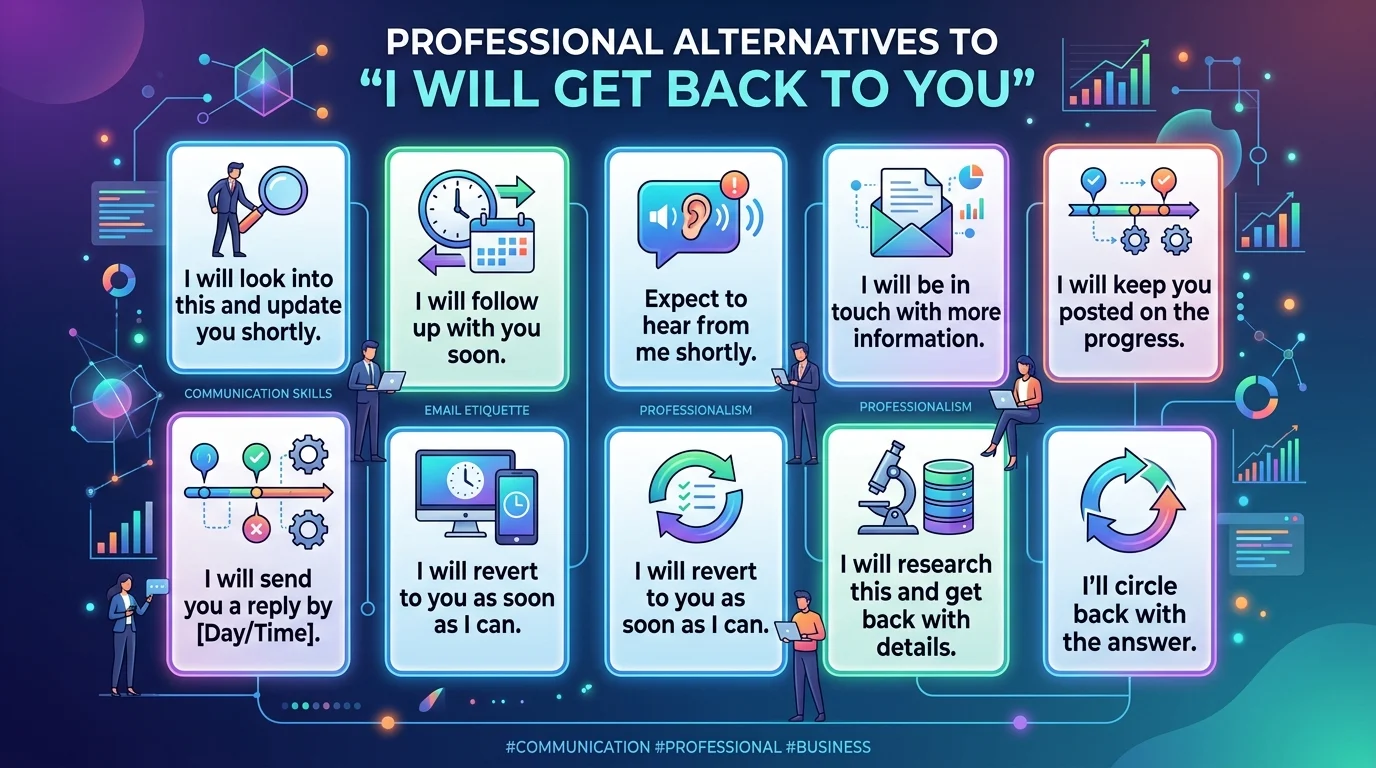
The phrase other ways to say i will get back to you is one of the most frequently used expressions in professional and everyday communication. People use it when they need additional time to gather information, review details, make a decision, consult with others, or provide a more complete response later. Whether you’re communicating with a client, manager, coworker, recruiter, customer, or friend,other ways to say i will get back to you helps set expectations and shows that you intend to follow up.
- What Does “I Will Get Back to You” Mean?
- Grammar Form
- Simple Definition
- Similar Expressions
- Opposite Expressions
- Example Sentences
- When to Use “I Will Get Back to You”
- Spoken English
- Business English
- Emails and Messages
- Customer Service
- Professional Meetings
- Recruitment and Hiring
- Is “I Will Get Back to You” Professional?
- Formal Tone
- Professional Tone
- Friendly Tone
- Informal Tone
- Workplace Tip
- Pros and Cons of Using “I Will Get Back to You”
- ✔ Pros
- ✘ Cons
- Quick Alternatives List
- I Will Follow Up With You
- Meaning
- Explanation
- Example Sentence
- Best Use
- Tone
- Similarity Score
- I'll Let You Know
- Meaning
- Example Sentence
- Best Use
- Tone
- Similarity Score
- I Will Keep You Updated
- Meaning
- Example Sentence
- Best Use
- Tone
- Similarity Score
- I Will Provide an Update
- Meaning
- Example Sentence
- Tone
- Similarity Score
- I'll Be in Touch
- Meaning
- Example Sentence
- Tone
- Similarity Score
- I'll Check and Let You Know
- Meaning
- Example Sentence
- Tone
- Similarity Score
- I'll Respond Shortly
- Meaning
- Example Sentence
- Tone
- Similarity Score
- I'll Circle Back
- Meaning
- Example Sentence
- Tone
- Similarity Score
- I Will Advise You Accordingly
- Meaning
- Example Sentence
- Tone
- Similarity Score
- I'll Notify You Once Confirmed
- Meaning
- Example Sentence
- Tone
- Similarity Score
- I'll Share an Update
- Meaning
- Example Sentence
- Tone
- Similarity Score
- I'll Review This and Respond
- Meaning
- Example Sentence
- Tone
- Similarity Score
- Mini Dialogue Examples
- Formal Dialogue
- Informal Dialogue
- Business Email Example
- Common Mistakes to Avoid
- Cultural and Tone Tips
- US English
- UK English
- Corporate Communication
- Customer Service
- Comparison Table
- Frequently Asked Questions
- Is “I will get back to you” professional?
- What is the most professional alternative?
- What is the friendliest alternative?
- Can I use it in business emails?
- What is the most formal alternative?
- Should I include a timeline?
- Conclusion
Although this phrase is clear and widely accepted, usingother ways to say i will get back to you repeatedly can make your communication sound repetitive. That is why many professionals, writers, students, and English learners search for other ways to say I will get back to you. Learning alternative expressions helps you sound more professional, confident, polished, and natural.
Understanding other ways to say I will get back to you can improve your business emails, workplace conversations, customer service interactions, networking messages, and everyday communication. Some alternatives sound formal and professional, while others feel friendly and conversational.
For example:
Professional: I will follow up with you once I have more information.other ways to say i will get back to you
Casual: I’ll let you know as soon as I can.
Both phrases communicate the same basic idea, but the tone differs significantly.other ways to say i will get back to you
What Does “I Will Get Back to You” Mean?
The phrase “I will get back to you” means that you cannot provide a complete answer immediately but intend to respond later with more information, clarification, or a decision.
People use I will get back to you when:
- Gathering information
- Reviewing documents
- Making decisions
- Consulting team members
- Checking availability
- Confirming details
When people search for other ways to say I will get back to you, they often want alternatives that sound more professional, formal, polite, or customer-friendly.other ways to say i will get back to youother ways to say i will get back to you..
Grammar Form
I will get back to you is a future-tense verb phrase.other ways to say i will get back to you.
Simple Definition
It means:
“I will contact you again with an answer or update.”other ways to say i will get back to you.
Similar Expressions
- I’ll follow up
- I’ll let you know
- I’ll update you
- I’ll respond shortly
- I’ll keep you informed
Opposite Expressions
- Here’s the answer now
- I can confirm immediately
- No follow-up is needed
Example Sentences
- I will get back to you after reviewing the proposal.
- I will get back to you once I have more information.
When to Use “I Will Get Back to You”
Spoken English
Common in everyday conversations.
Example:
“I need to check my schedule. I’ll get back to you.”
Business English
Frequently used in workplace communication.
Example:
“I will get back to you after consulting the team.”other ways to say i will get back to you.
Emails and Messages
Very common in professional emails.
Example:
“I’ll get back to you with an update tomorrow.”
Customer Service
Useful when resolving issues.
Example:
“We will get back to you as soon as possible.”
Professional Meetings
Helpful when information is unavailable.
Example:
“I’ll get back to everyone once the figures are finalized.”
Recruitment and Hiring
Common in interview processes.
Example:
“We will get back to you regarding our decision.”
Is “I Will Get Back to You” Professional?
Yes. It is generally professional and acceptable in most situations.other ways to say i will get back to you.
Formal Tone
Moderately formal.
Professional Tone
Widely accepted.
Friendly Tone
Natural and approachable.
Informal Tone
Common in daily conversations.
Workplace Tip
In highly professional emails, alternatives like I will follow up with you, I will provide an update, or I will respond once I have reviewed the details often sound more polished than other ways to say i will get back to you.other ways to say i will get back to you.
Pros and Cons of Using “I Will Get Back to You”
✔ Pros
- Clear and direct
- Professional
- Easy to understand
- Sets expectations
- Suitable for most situations
- Commonly accepted
✘ Cons
- Can sound repetitive
- Sometimes vague
- Doesn’t specify a timeline
- Overused in workplace communication
Quick Alternatives List
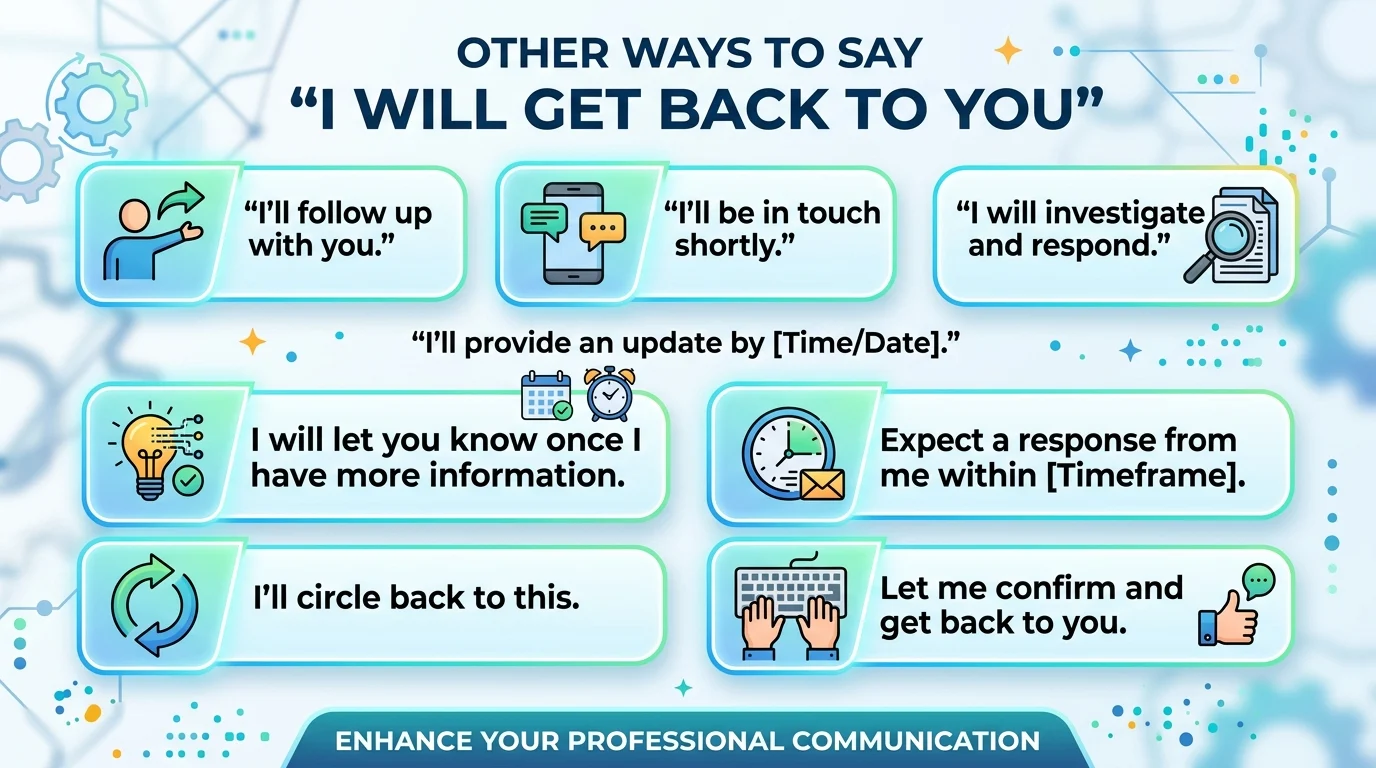
- I will follow up with you
- I’ll let you know
- I will keep you updated
- I will provide an update
- I will reach out soon
- I’ll respond shortly
- I’ll get back with more information
- I’ll check and let you know
- I’ll circle back
- I’ll be in touch
- I’ll update you soon
- I will advise you accordingly
- I’ll confirm once finalized
- I’ll reconnect shortly
- I’ll share an update
- I’ll review this and respond
- I’ll contact you again
- I’ll provide further details
- I’ll notify you once confirmed
- I’ll return with an answer
I Will Follow Up With You
Meaning
You will contact the person again later.
Explanation
One of the most professional alternatives to I will get back to you.
Example Sentence
I will follow up with you once the review is complete.
Best Use
Business emails, workplace communication.
Tone
Professional.
Similarity Score
10/10
I’ll Let You Know
Meaning
You will provide information later.
Example Sentence
I’ll let you know when I receive confirmation.
Best Use
Casual and professional settings.
Tone
Friendly Professional.
Similarity Score
10/10
I Will Keep You Updated
Meaning
You will provide ongoing updates.
Example Sentence
I will keep you updated throughout the process.
Best Use
Projects and client communication.
Tone
Professional.
Similarity Score
9/10
I Will Provide an Update
Meaning
You will share new information later.
Example Sentence
I will provide an update by the end of the week.
Tone
Professional.
Similarity Score
9/10
I’ll Be in Touch
Meaning
You will contact someone again soon.
Example Sentence
Thank you for your time. I’ll be in touch.
Tone
Friendly Professional.
Similarity Score
9/10
I’ll Check and Let You Know
Meaning
You need to verify information first.
Example Sentence
I’ll check with the team and let you know tomorrow.
Tone
Professional.
Similarity Score
9/10
I’ll Respond Shortly
Meaning
You will reply soon.
Example Sentence
I’ll respond shortly after reviewing the documents.
Tone
Professional.
Similarity Score
8/10
I’ll Circle Back
Meaning
You will return to the discussion later.
Example Sentence
I’ll circle back once we’ve completed the analysis.
Tone
Modern Professional.
Similarity Score
8/10
I Will Advise You Accordingly
Meaning
You will provide information after evaluation.
Example Sentence
I will advise you accordingly once the matter is reviewed.
Tone
Formal.
Similarity Score
8/10
I’ll Notify You Once Confirmed
Meaning
You will communicate when details are finalized.
Example Sentence
I’ll notify you once the appointment is confirmed.
Tone
Professional.
Similarity Score
8/10
I’ll Share an Update
Meaning
You will provide progress information.
Example Sentence
I’ll share an update during tomorrow’s meeting.
Tone
Professional.
Similarity Score
8/10
I’ll Review This and Respond
Meaning
You need time to evaluate before replying.
Example Sentence
I’ll review this and respond by Friday.
Tone
Professional.
Similarity Score
9/10
Mini Dialogue Examples
Formal Dialogue
Client:
Do you have an answer regarding the proposal?
Manager:
Not yet. I will follow up with you once our team completes the review.
Informal Dialogue
Friend:
Can you come this weekend?
Friend:
I’m not sure yet. I’ll let you know tomorrow.
Business Email Example
Subject: Proposal Review Update
Dear Sarah,
Thank you for your email. I am currently reviewing the proposal and will provide an update by Thursday. If I require any additional information, I will reach out accordingly.
Best regards,
Michael
Common Mistakes to Avoid
- Using I will get back to you without giving a timeline.
- Repeating the phrase throughout the same email.
- Promising a response and failing to follow up.
- Using casual alternatives in formal business communication.
- Being too vague about next steps.
- Overusing corporate jargon.
- Forgetting to acknowledge the person’s request.
Cultural and Tone Tips
US English
“I’ll let you know” is widely used and sounds natural.
UK English
“I will follow up with you” often sounds more professional.
Corporate Communication
Specific timelines are preferred over vague promises.
Customer Service
Alternatives like we will provide an update shortly sound more reassuring.
Comparison Table
| Phrase | Tone | Best Context | Professional Level | Example |
|---|---|---|---|---|
| I will follow up with you | Professional | Business emails | High | I will follow up with you tomorrow. |
| I’ll let you know | Friendly Professional | General communication | Medium | I’ll let you know soon. |
| I will keep you updated | Professional | Projects | High | I will keep you updated. |
| I’ll be in touch | Friendly Professional | Networking | Medium | I’ll be in touch next week. |
| I will provide an update | Formal | Workplace | High | I will provide an update shortly. |
| I’ll check and let you know | Neutral | Daily communication | Medium | I’ll check and let you know. |
| I will advise you accordingly | Formal | Corporate communication | Very High | I will advise you accordingly. |
Frequently Asked Questions
Is “I will get back to you” professional?
Yes, it is widely accepted in workplace communication.
What is the most professional alternative?
I will follow up with you is among the most professional options.
What is the friendliest alternative?
I’ll let you know sounds natural and friendly.
Can I use it in business emails?
Absolutely. It is common in professional correspondence.
What is the most formal alternative?
I will advise you accordingly is highly formal.
Should I include a timeline?
Yes. Adding a timeframe makes your communication clearer and more professional.
Conclusion
Learning other ways to say I will get back to you can improve your communication and help you sound more professional, confident, and effective. While I will get back to you remains a useful phrase, alternatives such as I will follow up with you, I’ll let you know, I will provide an update, and I’ll be in touch can add variety and precision to your writing. By choosing the right expression for the situation, you can create clearer expectations and build stronger professional relationships.