

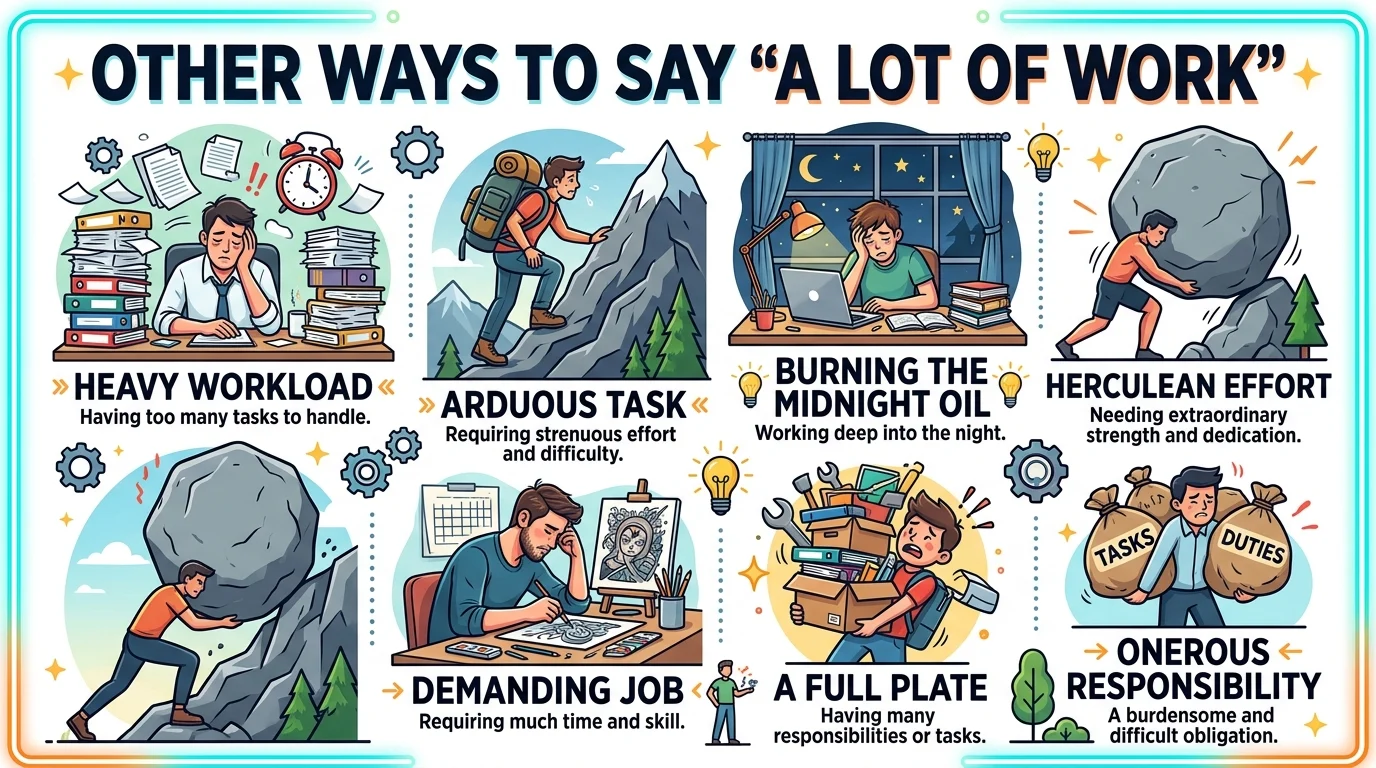
The phrase “other ways to say a lot of work” is commonly used in English to describe tasks, responsibilities, or projects that require significant time, effort, or energy. It is simple, widely understood, and used in both spoken and written communication. Whether you’re talking about school assignments, office projects, household tasks, or personal goals, this phrase helps express workload easily.
- What Does “A Lot of Work” Mean?
- Grammar Form
- Simple Definition
- Similar Expressions
- Opposite Expressions
- Example Sentences
- When to Use “A Lot of Work”
- Spoken English
- Business English
- Emails
- Academic Writing
- Professional Meetings
- Is “A Lot of Work” Professional?
- Formal Tone
- Professional Tone
- Informal Tone
- Workplace Tip
- Pros and Cons of Using “A Lot of Work”
- ✔ Pros
- ✘ Cons
- Quick Alternatives List
- Heavy Workload
- Meaning
- Explanation
- Example Sentence
- Best Use
- Tone
- Similarity Score
- Significant Effort
- Meaning
- Example Sentence
- Tone
- Similarity Score
- Time-Consuming Task
- Meaning
- Example Sentence
- Tone
- Similarity Score
- Demanding Work
- Meaning
- Example Sentence
- Tone
- Similarity Score
- Extensive Effort
- Meaning
- Example Sentence
- Tone
- Similarity Score
- Challenging Assignment
- Meaning
- Example Sentence
- Tone
- Similarity Score
- Labor-Intensive Work
- Meaning
- Example Sentence
- Tone
- Similarity Score
- Major Task
- Meaning
- Example Sentence
- Tone
- Similarity Score
- Complex Project
- Meaning
- Example Sentence
- Tone
- Similarity Score
- Substantial Workload
- Meaning
- Example Sentence
- Tone
- Similarity Score
- Mini Dialogue Examples
- Formal Dialogue
- Informal Dialogue
- Email Example
- Common Mistakes to Avoid
- Cultural and Tone Tips
- US English
- UK English
- Workplace Communication
- Academic Writing
- Comparison Table
- Frequently Asked Questions
- Is “a lot of work” professional?
- What is the most professional alternative?
- What is the simplest alternative?
- Can I use it in emails?
- What should beginners use?
- Conclusion
However, repeating other ways to say a lot of work too often can make your writing sound basic or repetitive. That is why many learners and professionals search for other ways to say a lot of work. Using alternative expressions helps you sound more precise, polished, and professional, especially in emails, reports, resumes, and business communication.
Learning other ways to say a lot of work can improve your vocabulary and help you describe workload more effectively in different contexts. Some alternatives sound formal and professional, while others are more casual or descriptive depending on the situation.
For example:
Professional: This project requires significant effort and time.other ways to say a lot of work.
Casual: This is a lot of work.
Both sentences mean the same thing, but the tone is different.other ways to say a lot of work.
What Does “A Lot of Work” Mean?
The phrase a lot of work means a task or activity that requires a large amount of effort, time, or energy to complete.other ways to say a lot of work.
People use it when describing:
- Workload at the office
- School assignments
- Project tasks
- Household chores
- Business responsibilities
- Personal goals
When people search for other ways to say a lot of work, they usually want more formal, descriptive, or professional alternatives.
Grammar Form
Noun phrase
Simple Definition
It means:
“A task that requires much effort or time.”
Similar Expressions
- Heavy workload
- Big task
- Hard work
- Time-consuming work
- Demanding task
Opposite Expressions
- Easy task
- Light work
- Simple job
- Quick task
- Minimal effort
Example Sentences
- This report is a lot of work.
- Managing this project is a lot of work for one person.
When to Use “A Lot of Work”
Spoken English
Very common in everyday speech.
“This assignment is a lot of work.”
Business English
Used to describe workload.
“This project is a lot of work for the team.”
Emails
Often used informally in workplace messages.
“This task is a lot of work, but I’ll handle it.”
Academic Writing
Usually replaced with more formal alternatives.
“The assignment requires extensive effort.”other ways to say a lot of work.
Professional Meetings
Used when discussing resources and planning.
“This initiative involves a lot of work from multiple departments.”
Is “A Lot of Work” Professional?
Yes, but it is more neutral and informal than formal.
Formal Tone
Less preferred in reports
Professional Tone
Acceptable in conversation
Informal Tone
Very common
Workplace Tip
In formal writing, use phrases like “significant effort,” “extensive work,” or “demanding task” instead of “a lot of work.”
Pros and Cons of Using “A Lot of Work”
✔ Pros
- Simple and clear
- Easy to understand
- Common in speech
- Works in everyday communication
- Natural expression
✘ Cons
- Too basic for formal writing
- Overused in professional documents
- Not precise enough
- Can sound informal in reports
Quick Alternatives List
- Heavy workload
- Significant effort
- Time-consuming task
- Demanding work
- Extensive effort
- Large amount of work
- Major task
- Complex project
- Challenging assignment
- Labor-intensive work
- Big responsibility
- Intensive task
- Substantial workload
- Lengthy process
- Resource-heavy task
- High-effort work
- Difficult assignment
- Work-intensive project
- Major undertaking
- Complicated work
Heavy Workload
Meaning
A large amount of work to complete.other ways to say a lot of work.
Explanation
Common in professional and office environments.
Example Sentence
The team is currently handling a heavy workload.
Best Use
Workplace communication
Tone
Professional
Similarity Score
10/10
Significant Effort
Meaning
Requires a lot of energy or work.
Example Sentence
This project requires significant effort from everyone.
Tone
Formal
Similarity Score
9/10
Time-Consuming Task
Meaning
A task that takes a long time to complete.other ways to say a lot of work.
Example Sentence
Data analysis is a time-consuming task.
Tone
Professional
Similarity Score
9/10
Demanding Work
Meaning
Work that requires a lot of effort or attention.
Example Sentence
Customer support is demanding work.
Tone
Professional
Similarity Score
9/10
Extensive Effort
Meaning
A large amount of effort required.
Example Sentence
The report requires extensive effort to complete.
Tone
Formal
Similarity Score
9/10
Challenging Assignment
Meaning
A difficult task to complete.
Example Sentence
This is a challenging assignment for the team.
Tone
Professional
Similarity Score
8/10
Labor-Intensive Work
Meaning
Work that requires physical or mental effort.
Example Sentence
Construction is highly labor-intensive work.
Tone
Formal
Similarity Score
8/10
Major Task
Meaning
An important and large task.
Example Sentence
Preparing the proposal is a major task.
Tone
Neutral Professional
Similarity Score
8/10
Complex Project
Meaning
A project with many parts or difficulties.
Example Sentence
This is a complex project requiring coordination.
Tone
Professional
Similarity Score
8/10
Substantial Workload
Meaning
A large and important amount of work.
Example Sentence
The department has a substantial workload this quarter.
Tone
Formal
Similarity Score
9/10
Mini Dialogue Examples
Formal Dialogue
Manager: Is this task difficult?
Employee: Yes, it requires significant effort and time.
Informal Dialogue
Friend: Is it easy?
Friend: No, it’s a lot of work!
Email Example
Subject: Project Update
Dear Team,
This project involves a heavy workload and will require careful coordination and significant effort from everyone.
Best regards,
Project Manager
Common Mistakes to Avoid
- Using “a lot of work” in formal reports
- Not specifying the type of workload
- Overusing vague expressions
- Mixing casual and formal tone
- Using informal phrases in academic writing
- Ignoring context (work vs study)
- Repeating the same phrase in emails
Cultural and Tone Tips
US English
“A lot of work” is very common in everyday speech.
UK English
More formal alternatives are preferred in writing.
Workplace Communication
“Heavy workload” is standard in business environments.
Academic Writing
Prefer “extensive effort” or “demanding task.”
Comparison Table
| Phrase | Tone | Best Context | Professional Level | Example |
|---|---|---|---|---|
| Heavy workload | Professional | Workplace | High | The team has a heavy workload. |
| Significant effort | Formal | Reports | High | This requires significant effort. |
| Time-consuming task | Professional | Projects | Medium | It is a time-consuming task. |
| Demanding work | Professional | Business | High | This is demanding work. |
| Extensive effort | Formal | Academic | Very High | The project requires extensive effort. |
| Complex project | Professional | Technical work | Medium | This is a complex project. |
| A lot of work | Neutral | Everyday speech | Low | This is a lot of work. |
Frequently Asked Questions
Is “a lot of work” professional?
It is acceptable in speech but less formal in writing.
What is the most professional alternative?
“Heavy workload” or “significant effort.”
What is the simplest alternative?
“Big task” or “demanding work.”
Can I use it in emails?
Yes, but formal alternatives are better.
What should beginners use?
“Heavy workload” and “time-consuming task.”
Conclusion
Learning other ways to say a lot of work helps you express ideas more clearly and professionally. While a lot of work is simple and widely used, alternatives like heavy workload, significant effort, time-consuming task, and demanding work make your communication more precise and suitable for formal settings. Whether you are writing emails, reports, or academic content, these alternatives will help you sound more polished and confident.