


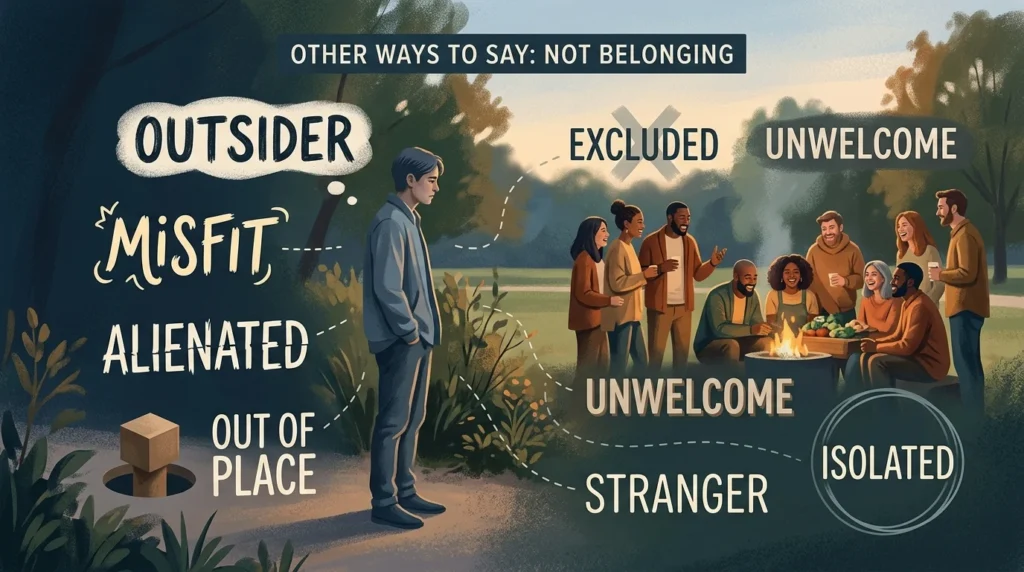
If you’re searching for other ways to say not belonging, you’re likely looking for alternative expressions that convey feelings of exclusion, disconnection, isolation, or being out of place. The phrase not belonging is commonly used in personal conversations, essays, workplace discussions, literature, and mental health topics to describe the experience of feeling disconnected from a group,other ways to say not belonging, community, environment, or social setting.
- What Does "Not Belonging" Mean?
- Examples
- Why Use Alternatives to "Not Belonging"?
- Add Variety
- Improve Emotional Expression
- Sound More Professional
- Enhance Storytelling
- 1. Feeling Out of Place
- Example
- Best Use
- 2. Feeling Disconnected
- Example
- Best Use
- 3. Feeling Excluded
- Example
- Best Use
- 4. Feeling Isolated
- Example
- Best Use
- 5. Feeling Alienated
- Example
- Best Use
- 6. Feeling Like an Outsider
- Example
- 7. Feeling Unwelcome
- Example
- 8. Feeling Detached
- Example
- 9. Feeling Left Out
- Example
- 10. Feeling Different
- Example
- 11. Being on the Outside Looking In
- Example
- 12. Feeling Unaccepted
- Example
- 13. Feeling Separate
- Example
- 14. Feeling Estranged
- Example
- 15. Feeling Marginalized
- Example
- 16. Feeling Rejected
- Example
- 17. Feeling Unincluded
- Example
- 18. Being an Outsider
- Example
- 19. Feeling Invisible
- Example
- 20. Feeling Unconnected
- Example
- Example
- Academic Options
- Example
- Example
- Original
- Alternative
- Original
- Alternative
- Original
- Alternative
- Original
- Alternative
- Original
- Alternative
- Original
- Alternative
- Using Overly Dramatic Terms
- Ignoring Context
- Repeating the Same Phrase
- Confusing Isolation with Exclusion
- Is "not belonging" grammatically correct?
- What is the most professional alternative?
- What is the best academic alternative?
- What is the best emotional alternative?
- What is the strongest synonym?
While not belonging is clear and widely understood, using the same phrase repeatedly can make your writing feel repetitive. Learning other ways to say not belonging can help you communicate emotions more precisely while making your writing richer and more engaging.
Whether you’re writing a personal essay, other ways to say not belonging,academic paper, blog post, story, journal entry, or workplace document, having a variety of alternatives can improve both clarity and impact.
In this guide, you’ll discover 45+ other ways to say not belonging,other ways to say not belonging, along with meanings, examples, and practical usage tips.
What Does “Not Belonging” Mean?
The phrase not belonging refers to feeling disconnected, excluded,other ways to say not belonging, unwelcome, different, or out of place in a particular environment or group.
Examples
- Feeling like you don’t fit into a workplace.
- Feeling disconnected from a community.
- Feeling excluded from a social group.
- Feeling different from those around you.
- Feeling unwelcome in a new environment.
Because these experiences can vary significantly, people often search for other ways to say not belonging to find words that better express their specific situation.
Why Use Alternatives to “Not Belonging”?
Add Variety
Repeated phrases can make writing sound repetitive.
Improve Emotional Expression
Different alternatives capture different emotions.
Sound More Professional
Some alternatives are better suited for academic or workplace writing.
Enhance Storytelling
Precise language creates stronger imagery and emotional impact.
45 Other Ways to Say Not Belonging
1. Feeling Out of Place
Example
I felt out of place at the conference.
Best Use
Everyday conversations and essays.
2. Feeling Disconnected
Example
She felt disconnected from her coworkers.
Best Use
Professional and personal writing.
3. Feeling Excluded
Example
He often felt excluded from group discussions.
Best Use
Workplace and social situations.
4. Feeling Isolated
Example
Moving to a new city left her feeling isolated.
Best Use
Emotional and personal writing.
5. Feeling Alienated
Example
The employee felt alienated after the organizational changes.
Best Use
Academic and professional contexts.
6. Feeling Like an Outsider
Example
I felt like an outsider in the new school.
7. Feeling Unwelcome
Example
The guest felt unwelcome during the event.
8. Feeling Detached
Example
He felt detached from the team.
9. Feeling Left Out
Example
She felt left out of the conversation.
10. Feeling Different
Example
Many teenagers struggle with feeling different.
11. Being on the Outside Looking In
Example
He felt like he was on the outside looking in.
12. Feeling Unaccepted
Example
She felt unaccepted by her peers.
13. Feeling Separate
Example
The new employee felt separate from the rest of the staff.
14. Feeling Estranged
Example
He felt estranged from his community.
15. Feeling Marginalized
Example
Some groups may feel marginalized in society.
16. Feeling Rejected
Example
She felt rejected by the group.
17. Feeling Unincluded
Example
The student felt unincluded during activities.
18. Being an Outsider
Example
Being an outsider can be challenging in a new environment.
19. Feeling Invisible
Example
He often felt invisible among his colleagues.
20. Feeling Unconnected
Example
She felt unconnected to the organization’s culture.
Professional Alternatives
When discussing workplace experiences, these alternatives often work better than not belonging:
- Feeling disconnected
- Feeling excluded
- Feeling detached
- Feeling alienated
- Feeling unconnected
- Feeling isolated
- Feeling marginalized
- Feeling separate
- Lacking inclusion
- Experiencing disconnection
Example
Instead of:
I felt like I didn’t belong at work.
Use:
I felt disconnected from the workplace culture.
Academic Alternatives
Students frequently search for other ways to say not belonging when writing essays and research papers.
Academic Options
- Alienated
- Marginalized
- Excluded
- Detached
- Estranged
- Socially isolated
- Disconnected
- Unintegrated
- Unaccepted
- Disenfranchised
Example
The study examined how marginalized individuals experience feelings of social exclusion.
Emotional Alternatives
For personal stories and reflective writing:
- Out of place
- Left out
- Invisible
- Unwelcome
- Rejected
- Isolated
- Different
- Alone
- Unaccepted
- Misunderstood
Example
During my first year at university, I often felt out of place.
Workplace Examples
Original
I felt like I didn’t belong on the team.
Alternative
I felt disconnected from the team dynamic.
Original
She didn’t feel like she belonged in the company.
Alternative
She felt detached from the company culture.
Original
The new employee felt like an outsider.
Alternative
The new employee felt excluded from workplace interactions.
Alternatives for Essays
Original
The character experiences a sense of not belonging.
Alternative
The character experiences feelings of alienation.
Original
The protagonist struggles with not belonging.
Alternative
The protagonist struggles with social exclusion.
Original
She feels she doesn’t belong in society.
Alternative
She feels marginalized within society.
Comparison Table
| Alternative | Formality | Best Use |
|---|---|---|
| Out of Place | Medium | Essays |
| Disconnected | High | Workplace |
| Excluded | High | Professional |
| Isolated | Medium | Personal Writing |
| Alienated | Very High | Academic |
| Detached | High | Professional |
| Outsider | Medium | General Use |
| Marginalized | Very High | Research |
| Left Out | Low | Casual Use |
| Estranged | High | Literature |
Common Mistakes to Avoid
Using Overly Dramatic Terms
Choose alternatives that accurately reflect the situation.
Ignoring Context
Different settings require different levels of formality.
Repeating the Same Phrase
Vary your language naturally.
Confusing Isolation with Exclusion
Isolation and exclusion are related but not always identical.
Frequently Asked Questions
Is “not belonging” grammatically correct?
Yes. It is a common and correct phrase.
What is the most professional alternative?
“Feeling disconnected” is often the most professional option.
What is the best academic alternative?
“Alienated” and “marginalized” are strong academic choices.
What is the best emotional alternative?
“Feeling out of place” is widely used and relatable.
What is the strongest synonym?
“Alienated” is often considered one of the strongest alternatives.
Conclusion
Learning other ways to say not belonging can help you express feelings of exclusion, disconnection, and isolation more effectively. While not belonging remains a useful phrase, alternatives such as feeling out of place, feeling disconnected, feeling excluded, feeling isolated, and feeling alienated can provide greater precision and emotional depth. By selecting the right alternative for your audience and purpose, you can create writing that is more engaging, meaningful, and impactful.