

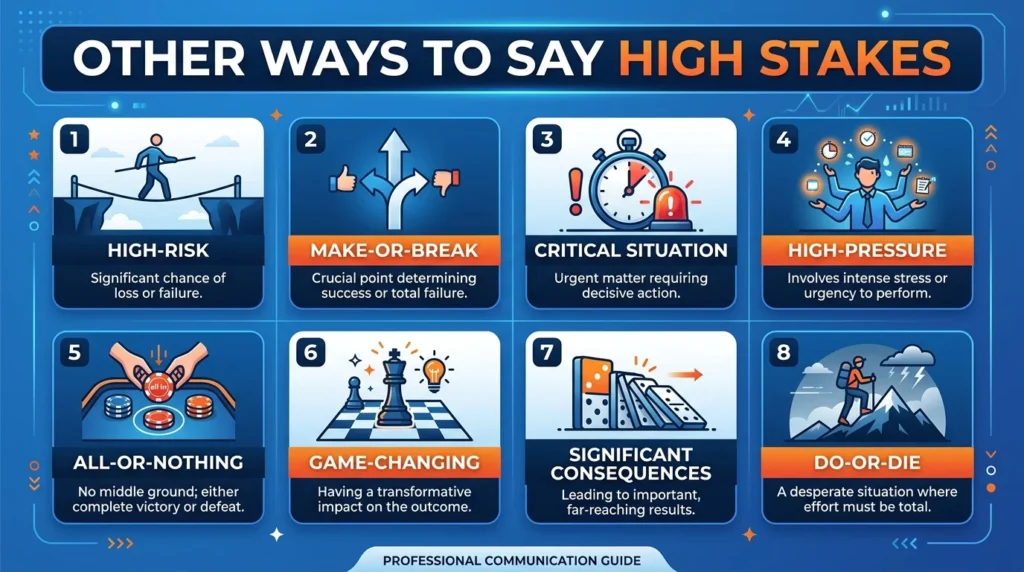
Other ways to say high stakes can help make your writing more precise, professional, and engaging. The phrase high stakes is commonly used to describe situations where the consequences are significant, risks are substantial, or outcomes are especially important. While it is a powerful expression, other ways to say high stakes,using it repeatedly can make your communication feel repetitive.
- Grammar Form
- Student-Friendly Definition
- Example Sentences
- Business Decisions
- Academic Writing
- Workplace Communication
- Presentations
- Sports Discussions
- Leadership Contexts
- Formal
- Professional
- Academic
- Workplace Tip
- ✔ Pros
- ✘ Cons
- Meaning
- Explanation
- Example Sentence
- Best Use
- Tone
- Similarity Score
- Meaning
- Explanation
- Example Sentence
- Best Use
- Tone
- Similarity Score
- Meaning
- Explanation
- Example Sentence
- Best Use
- Tone
- Similarity Score
- Meaning
- Explanation
- Example Sentence
- Best Use
- Tone
- Similarity Score
- Meaning
- Explanation
- Example Sentence
- Best Use
- Tone
- Similarity Score
- Meaning
- Explanation
- Example Sentence
- Best Use
- Tone
- Similarity Score
- Meaning
- Explanation
- Example Sentence
- Best Use
- Tone
- Similarity Score
- Meaning
- Explanation
- Example Sentence
- Best Use
- Tone
- Similarity Score
- Meaning
- Explanation
- Example Sentence
- Best Use
- Tone
- Similarity Score
- Meaning
- Explanation
- Example Sentence
- Best Use
- Tone
- Similarity Score
- Formal Dialogue
- Informal Dialogue
- Business Email Example
- US English
- UK English
- Business Communication
- Academic Writing
- Is “high stakes” professional?
- What is the most formal alternative?
- What is best for business writing?
- What is best for academic essays?
- What is best for presentations?
- What should beginners use?
Many professionals, students, and writers search for other ways to say high stakes when preparing reports, essays, presentations, business proposals, other ways to say high stakes,or workplace communications. Choosing the right alternative allows you to match the tone of your audience while clearly communicating the seriousness of a situation.
Learning other ways to say high stakes can strengthen your writing by adding variety and helping you emphasize risk, importance, urgency,other ways to say high stakes, or responsibility more effectively.
For example:
Standard: This is a high-stakes decision.
Alternative: This is a critical decision with significant consequences.
The second sentence sounds more formal and descriptive.
What Does “High Stakes” Mean?
The phrase high stakes refers to situations involving major risks, other ways to say high stakes,important outcomes, significant consequences, or substantial rewards.
People often look for other ways to say high stakes to make their writing sound more professional, academic, or persuasive.
Grammar Form
Adjective phrase.
Student-Friendly Definition
A situation where a lot can be gained or lost.
Example Sentences
- The company faces a high-stakes negotiation.
- It was a high-stakes examination for students.
When to Use “High Stakes”
Business Decisions
When discussing important choices.
Academic Writing
When analyzing significant events.
Workplace Communication
When emphasizing consequences.
Presentations
When highlighting risks or opportunities.
Sports Discussions
When describing important competitions.
Leadership Contexts
When discussing major responsibilities.
Is “High Stakes” Professional?
Yes. It is widely accepted in professional communication.
Formal
- Critical
- Consequential
Professional
- High-Risk
- Significant
Academic
- Impactful
- Outcome-Driven
Workplace Tip
Choose alternatives that explain why the situation is important rather than simply calling it high stakes.
Pros and Cons of Using “High Stakes”
✔ Pros
- Easy to understand
- Widely recognized
- Conveys urgency
- Highlights importance
- Works across industries
✘ Cons
- Can be overused
- Sometimes lacks specificity
- May sound dramatic
- Less effective when repeated frequently
Quick Alternatives List
- Critical
- Consequential
- High-Risk
- Significant
- Crucial
- Pivotal
- Important
- Impactful
- Serious
- Mission-Critical
- Outcome-Driven
- Pressing
- Decisive
- Vital
- Far-Reaching
- Risk-Intensive
- Momentous
- Weighty
- Demanding
- Game-Changing
Critical
Meaning
Extremely important and requiring careful attention.
Explanation
One of the strongest other ways to say high stakes in professional writing.
Example Sentence
This is a critical decision for the future of the organization.
Best Use
Business and leadership communication.
Tone
Professional.
Similarity Score
10/10
Consequential
Meaning
Likely to produce important effects or results.
Explanation
A formal and academic alternative.
Example Sentence
The committee faces a highly consequential choice.
Best Use
Academic and policy discussions.
Tone
Formal.
Similarity Score
9/10
High-Risk
Meaning
Involving a substantial possibility of loss or failure.
Explanation
Highlights the danger associated with a situation.
Example Sentence
The project is considered a high-risk investment.
Best Use
Business and finance.
Tone
Professional.
Similarity Score
9/10
Significant
Meaning
Important or meaningful.
Explanation
A versatile alternative among other ways to say high stakes.
Example Sentence
The negotiation could have significant consequences.
Best Use
General professional writing.
Tone
Professional.
Similarity Score
8/10
Crucial
Meaning
Extremely important to success.
Explanation
Frequently used in business and academic contexts.
Example Sentence
This is a crucial stage of the project.
Best Use
Reports and presentations.
Tone
Professional.
Similarity Score
9/10
Pivotal
Meaning
Serving as a key turning point.
Explanation
Ideal for describing important moments.
Example Sentence
The meeting was pivotal to the company’s future.
Best Use
Business strategy and leadership.
Tone
Professional.
Similarity Score
8/10
Mission-Critical
Meaning
Essential to success or operation.
Explanation
Commonly used in technology and business.
Example Sentence
Data security is a mission-critical priority.
Best Use
Corporate environments.
Tone
Professional.
Similarity Score
8/10
Decisive
Meaning
Determining the final outcome.
Explanation
Focuses on the importance of a decision.
Example Sentence
The next vote will be decisive.
Best Use
Leadership and politics.
Tone
Formal.
Similarity Score
8/10
Momentous
Meaning
Very important and far-reaching.
Explanation
One of the more powerful other ways to say high stakes.
Example Sentence
The organization faces a momentous opportunity.
Best Use
Formal speeches and essays.
Tone
Formal.
Similarity Score
8/10
Game-Changing
Meaning
Capable of creating a major impact.
Explanation
A modern and engaging alternative.
Example Sentence
The innovation could be game-changing for the industry.
Best Use
Marketing and business discussions.
Tone
Professional but modern.
Similarity Score
7/10
Mini Dialogue Examples
Formal Dialogue
Executive:
How important is this merger?
Manager:
It is a critical decision with long-term implications.
Informal Dialogue
Friend:
Is the interview important?
Friend:
Definitely. It’s a pivotal moment for my career.
Business Email Example
Subject: Project Update
Dear Team,
We are approaching a crucial phase of the project. Careful planning and collaboration will be essential to ensure success.
Best regards,
David
Common Mistakes to Avoid
- Overusing dramatic language.
- Using “high stakes” without explaining the consequences.
- Choosing alternatives that exaggerate the situation.
- Repeating the same phrase throughout a document.
- Confusing “important” with “high-risk.”
- Using casual alternatives in formal reports.
- Ignoring context when selecting a synonym.
Cultural & Tone Tips
US English
Direct and impactful wording is common.
UK English
More measured language is often preferred.
Business Communication
Specific explanations strengthen credibility.
Academic Writing
Formal alternatives such as “consequential” work best.
Comparison Table
| Phrase | Tone | Best Context | Professional Level | Example |
|---|---|---|---|---|
| Critical | Professional | Business | Very High | Critical decision |
| Consequential | Formal | Academic | Very High | Consequential outcome |
| High-Risk | Professional | Finance | High | High-risk investment |
| Significant | Professional | General Use | High | Significant consequences |
| Crucial | Professional | Reports | High | Crucial stage |
| Pivotal | Professional | Strategy | High | Pivotal moment |
| Mission-Critical | Professional | Technology | High | Mission-critical task |
Frequently Asked Questions
Is “high stakes” professional?
Yes. It is widely used in professional and business settings.
What is the most formal alternative?
“Consequential” is one of the most formal alternatives.
What is best for business writing?
“Critical” and “crucial” are excellent choices.
What is best for academic essays?
“Consequential” and “significant” work very well.
What is best for presentations?
“Pivotal” and “critical” are effective options.
What should beginners use?
“Important,” “critical,” and “significant” are simple and professional.
Conclusion
Learning other ways to say high stakes can improve the clarity, professionalism, and impact of your communication. While high stakes remains a useful expression, alternatives such as critical, consequential, crucial, significant, and pivotal can help you describe important situations more effectively. Choosing the right phrase allows you to emphasize risk, responsibility, and importance while keeping your writing fresh and engaging.