
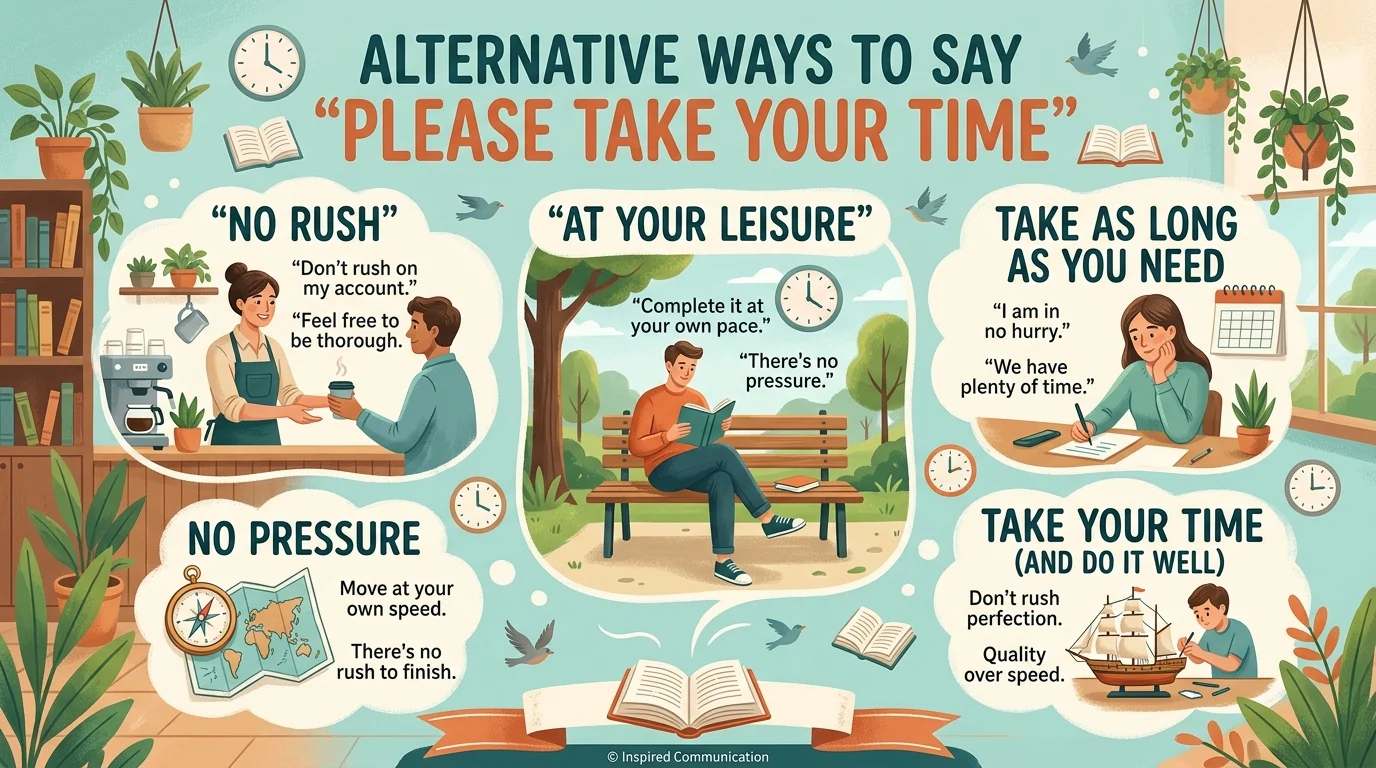
The phrase “please take your time” is a kind and thoughtful way to tell someone there is no need to rush. It shows patience, understanding, and respect for another person’s schedule or decision-making process. Whether you’re writing a professional email, speaking with a client, helping a coworker, or chatting with a friend, this phrase can help create a positive and relaxed atmosphere.
- What Does “Please Take Your Time” Mean?
- Grammar Form
- Simple Definition
- Similar Expressions
- Opposite Expressions
- Example Sentences
- When to Use “Please Take Your Time”
- Spoken English
- Business English
- Emails and Messages
- Customer Service
- Academic Communication
- Professional Meetings
- Is “Please Take Your Time” Professional?
- Formal Tone
- Professional Tone
- Friendly Tone
- Informal Tone
- Workplace Tip
- Pros and Cons of Using “Please Take Your Time”
- ✔ Pros
- ✘ Cons
- Quick Alternatives List
- No Rush
- Meaning
- Explanation
- Grammar Note
- Example Sentence
- Best Use
- Worst Use
- Tone
- Level
- Similarity Score
- Replaceability Tip
- Feel Free to Take Your Time
- Meaning
- Explanation
- Example Sentence
- Tone
- Similarity Score
- At Your Convenience
- Meaning
- Explanation
- Example Sentence
- Tone
- Similarity Score
- Whenever You're Ready
- Meaning
- Example Sentence
- Tone
- Similarity Score
- There's No Hurry
- Meaning
- Example Sentence
- Tone
- Similarity Score
- Don't Feel Rushed
- Meaning
- Example Sentence
- Tone
- Similarity Score
- Take All the Time You Need
- Meaning
- Example Sentence
- Tone
- Similarity Score
- Please Proceed at Your Own Pace
- Meaning
- Example Sentence
- Tone
- Similarity Score
- Review It When You Have Time
- Meaning
- Example Sentence
- Tone
- Similarity Score
- Feel Free to Think It Over
- Meaning
- Example Sentence
- Tone
- Similarity Score
- Get Back to Me When Convenient
- Meaning
- Example Sentence
- Tone
- Similarity Score
- Take a Moment to Consider It
- Meaning
- Example Sentence
- Tone
- Similarity Score
- No Need to Rush
- Meaning
- Example Sentence
- Tone
- Similarity Score
- Let Me Know When You're Ready
- Meaning
- Example Sentence
- Tone
- Similarity Score
- Consider It at Your Leisure
- Meaning
- Example Sentence
- Tone
- Similarity Score
- Mini Dialogue Examples
- Formal Dialogue
- Informal Dialogue
- Business Email Example
- Common Mistakes to Avoid
- Cultural and Tone Tips
- US English
- UK English
- Workplace Communication
- Casual Communication
- Comparison Table
- Frequently Asked Questions
- Is “please take your time” professional?
- Is it appropriate in emails?
- What is the most formal alternative?
- What is the friendliest alternative?
- What should beginners use?
- Can I use it with clients?
- Conclusion
However, using the same expression repeatedly can make your communication sound repetitive. That’s why many people search for other ways to say please take your time. Learning different alternatives can help you sound more professional, polite, supportive, or natural depending on the situation.
Understanding other ways to say please take your time can improve your English fluency, strengthen workplace communication, and help you choose the perfect phrase for emails, meetings, customer service, and everyday conversations.
For example:
Professional: Feel free to review it at your convenience.
Friendly: No rush at all.
Both phrases carry the same message, but the tone is different.
What Does “Please Take Your Time” Mean?
The phrase please take your time means that someone does not need to hurry and can proceed at a comfortable pace.
People often use this phrase when:
- Waiting for a response
- Allowing someone to make a decision
- Reviewing documents
- Completing a task
- Answering a question
- Providing feedback
When people search for other ways to say please take your time, they usually want alternatives that fit different levels of formality.
Grammar Form
The phrase is an imperative expression used politely.
Simple Definition
It means:
“You don’t need to hurry.”
Similar Expressions
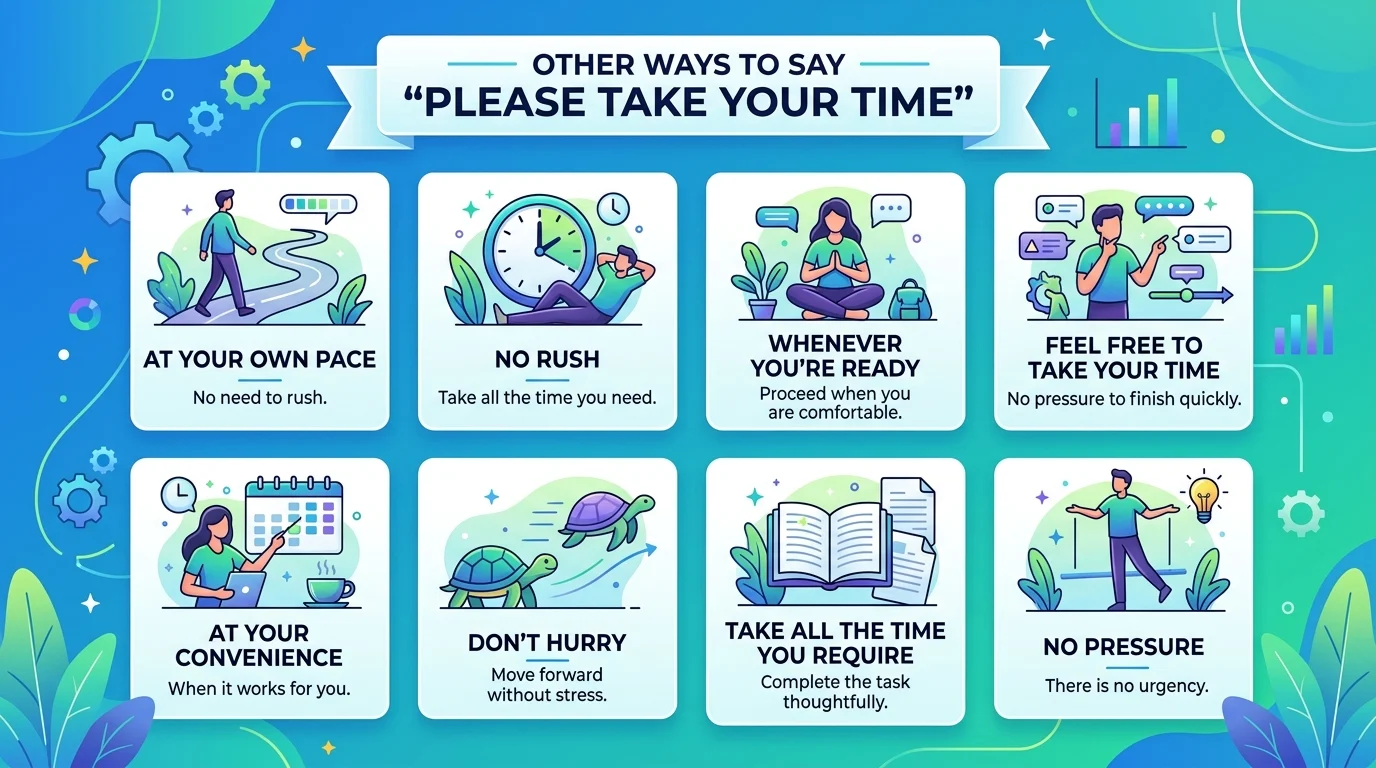
- No rush.
- Feel free to take your time.
- At your convenience.
- There’s no hurry.
- Whenever you’re ready.
Opposite Expressions
- Please hurry.
- As soon as possible.
- Immediately.
- Without delay.
Example Sentences
- Please take your time reviewing the proposal.
- Please take your time before making a decision.
When to Use “Please Take Your Time”
Spoken English
Often used during conversations.
Example:
“Please take your time. There’s no pressure.”
Business English
Useful when discussing projects or approvals.
Example:
“Please take your time reviewing the contract.”
Emails and Messages
Common in professional correspondence.
Example:
“Please take your time and let me know your thoughts.”
Customer Service
Shows patience and respect.
Example:
“Please take your time deciding which option works best for you.”
Academic Communication
Helpful when discussing assignments or research.
Example:
“Please take your time reviewing the feedback.”
Professional Meetings
Can reduce pressure and encourage thoughtful responses.
Example:
“Please take your time considering the proposal.”
Is “Please Take Your Time” Professional?
Yes. It is polite, professional, and widely accepted.
Formal Tone
Suitable for clients and managers.
Professional Tone
Excellent for workplace communication.
Friendly Tone
Works naturally in casual conversations.
Informal Tone
Can be shortened to “No rush.”
Workplace Tip
Among all other ways to say please take your time, this phrase remains one of the safest choices for professional emails.
Pros and Cons of Using “Please Take Your Time”
✔ Pros
- Polite
- Professional
- Encouraging
- Reduces pressure
- Easy to understand
- Suitable for emails and conversations
✘ Cons
- Can become repetitive
- May sound generic
- Sometimes too formal in casual chats
- Can delay urgent responses if used incorrectly
Quick Alternatives List
If you need other ways to say please take your time quickly, try these:
- No rush.
- Feel free to take your time.
- At your convenience.
- Whenever you’re ready.
- There’s no hurry.
- Don’t feel rushed.
- Take all the time you need.
- Please proceed at your own pace.
- Review it when you have time.
- Feel free to think it over.
- There’s no immediate deadline.
- Get back to me when convenient.
- Take a moment to consider it.
- Feel free to review it carefully.
- No need to rush.
- Please don’t feel pressured.
- Take your time deciding.
- Let me know when you’re ready.
- Consider it at your leisure.
- Respond whenever works for you.
No Rush
Meaning
There is no need to hurry.
Explanation
One of the most common and natural other ways to say please take your time.
Grammar Note
Informal phrase.
Example Sentence
No rush. Just let me know when you’re ready.
Best Use
Texts, casual emails.
Worst Use
Very formal legal documents.
Tone
Friendly.
Level
Beginner.
Similarity Score
10/10
Replaceability Tip
Perfect for casual workplace communication.
Feel Free to Take Your Time
Meaning
You may proceed at your own pace.
Explanation
A direct alternative to please take your time.
Example Sentence
Feel free to take your time reviewing the materials.
Tone
Professional.
Similarity Score
10/10
At Your Convenience
Meaning
Whenever it is suitable for you.
Explanation
A highly professional alternative.
Example Sentence
Please review the document at your convenience.
Tone
Formal.
Similarity Score
9/10
Whenever You’re Ready
Meaning
There is no pressure to act immediately.
Example Sentence
Whenever you’re ready, we can begin.
Tone
Friendly.
Similarity Score
9/10
There’s No Hurry
Meaning
You have plenty of time.
Example Sentence
There’s no hurry. We can discuss it later.
Tone
Friendly Professional.
Similarity Score
9/10
Don’t Feel Rushed
Meaning
Encourages careful consideration.
Example Sentence
Don’t feel rushed when making your decision.
Tone
Supportive.
Similarity Score
8/10
Take All the Time You Need
Meaning
Use as much time as necessary.
Example Sentence
Take all the time you need to think about it.
Tone
Warm.
Similarity Score
10/10
Please Proceed at Your Own Pace
Meaning
Move forward comfortably.
Example Sentence
Please proceed at your own pace.
Tone
Professional.
Similarity Score
8/10
Review It When You Have Time
Meaning
Look at it when your schedule allows.
Example Sentence
Review it when you have time and let me know.
Tone
Professional Friendly.
Similarity Score
8/10
Feel Free to Think It Over
Meaning
Take time to consider carefully.
Example Sentence
Feel free to think it over before deciding.
Tone
Supportive.
Similarity Score
8/10
Get Back to Me When Convenient
Meaning
Respond when it suits your schedule.
Example Sentence
Get back to me when convenient.
Tone
Professional.
Similarity Score
8/10
Take a Moment to Consider It
Meaning
Spend some time thinking before responding.
Example Sentence
Take a moment to consider it before making a choice.
Tone
Professional.
Similarity Score
7/10
No Need to Rush
Meaning
You can proceed slowly.
Example Sentence
No need to rush. We have plenty of time.
Tone
Friendly.
Similarity Score
10/10
Let Me Know When You’re Ready
Meaning
Respond whenever prepared.
Example Sentence
Let me know when you’re ready to move forward.
Tone
Professional Friendly.
Similarity Score
8/10
Consider It at Your Leisure
Meaning
Think about it whenever you like.
Example Sentence
Please consider it at your leisure.
Tone
Formal.
Similarity Score
7/10
Mini Dialogue Examples
Formal Dialogue
Manager:
Would you like some time to review the proposal?
Client:
Yes, thank you.
Manager:
Please review it at your convenience.
Informal Dialogue
Friend:
Sorry, I need a little more time.
Friend:
No rush. Take all the time you need.
Business Email Example
Dear Sarah,
Thank you for reviewing the proposal. Please take your time and let me know if you have any questions. There is no immediate deadline, so feel free to respond at your convenience.
Best regards,
Michael
Common Mistakes to Avoid
- Using “take your time” when something is urgent.
- Sounding passive when a deadline exists.
- Using overly casual alternatives in formal emails.
- Forgetting to mention deadlines if they apply.
- Using “no rush” with important time-sensitive tasks.
- Mixing formal and informal tones.
- Assuming everyone understands there is no deadline.
Cultural and Tone Tips
US English
“No rush” is very common and natural.
UK English
“At your convenience” is often preferred in professional settings.
Workplace Communication
Professional alternatives are appreciated when speaking with clients and managers.
Casual Communication
Short alternatives sound more natural and friendly.
Comparison Table
| Phrase | Tone | Best Context | Professional Level | Example |
|---|---|---|---|---|
| No rush | Friendly | Casual chats | Medium | No rush, take your time. |
| Feel free to take your time | Professional | Emails | High | Feel free to take your time reviewing it. |
| At your convenience | Formal | Business | Very High | Please respond at your convenience. |
| Whenever you’re ready | Friendly | Conversations | Medium | Whenever you’re ready, let’s begin. |
| There’s no hurry | Friendly Professional | Workplace | High | There’s no hurry to decide. |
| Take all the time you need | Warm | Supportive situations | High | Take all the time you need. |
| Get back to me when convenient | Professional | Emails | High | Get back to me when convenient. |
Frequently Asked Questions
Is “please take your time” professional?
Yes. It is widely used in professional communication.
Is it appropriate in emails?
Absolutely. It is polite and respectful.
What is the most formal alternative?
At your convenience.
What is the friendliest alternative?
No rush.
What should beginners use?
Feel free to take your time.
Can I use it with clients?
Yes. It is suitable for client communication.
Conclusion
Learning other ways to say please take your time can make your communication more natural, thoughtful, and professional. While the original phrase is polite and effective, using a variety of alternatives helps you adapt your tone to different situations. Whether you are writing emails, speaking with clients, helping coworkers, or chatting with friends, these alternatives can improve clarity and strengthen relationships. By practicing these expressions, you can become a more confident and flexible English communicator.