
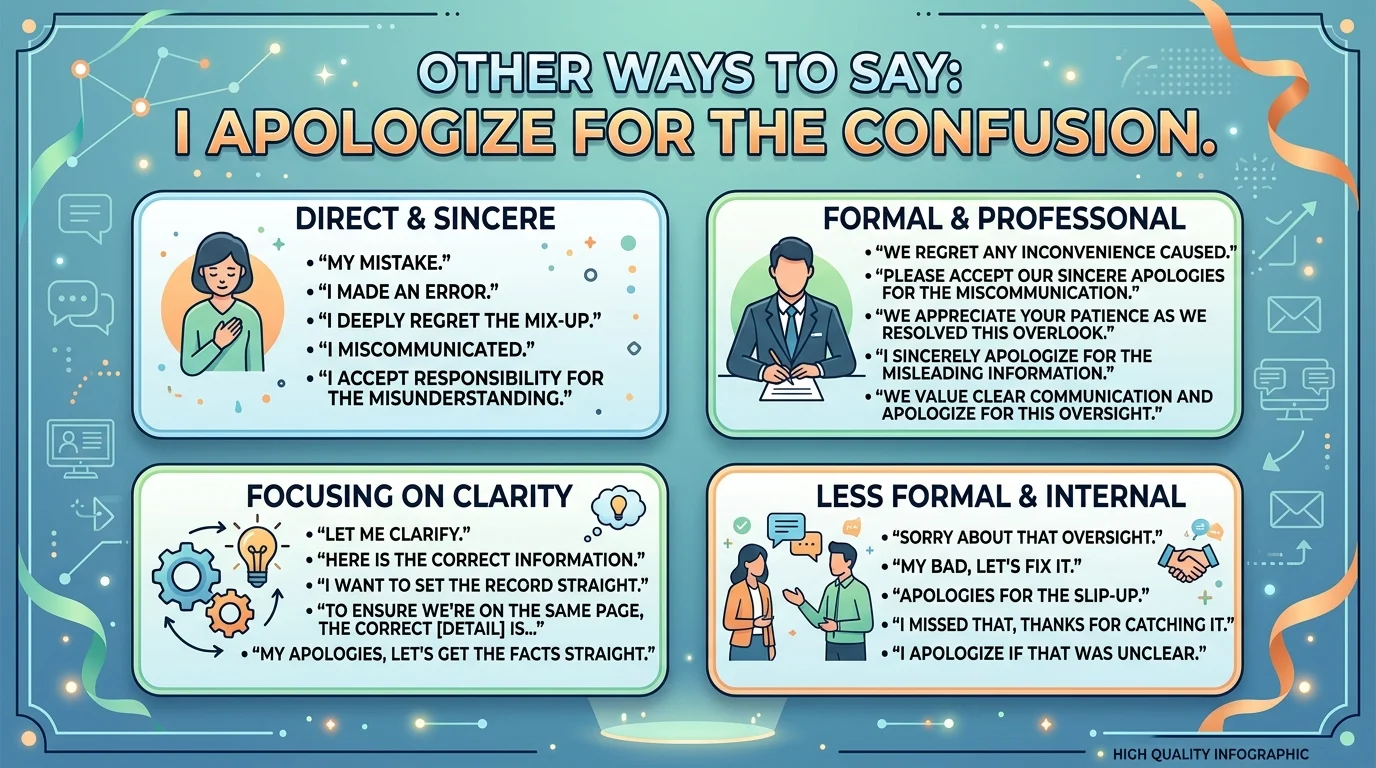
Learning other ways to say I apologize for the confusion can make your English sound more natural, professional, and confident. While I apologize for the confusion is a polite phrase, using the same expression repeatedly can make emails, workplace communication, and customer service responses feel repetitive.
- What Does “I Apologize for the Confusion” Mean?
- Grammar Form
- Similar Expressions
- Opposite Tone
- Example Sentences
- When to Use “I Apologize for the Confusion”
- Spoken English
- Business English
- Emails and Messages
- Social Media
- Academic Writing
- Professional Meetings
- Is “I Apologize for the Confusion” Polite or Professional?
- Polite Tone
- Neutral Tone
- Strong Tone
- Soft Tone
- Formal vs Informal
- Etiquette Tip
- Pros and Cons of Using “I Apologize for the Confusion”
- ✔ Pros
- ✘ Cons
- Quick Alternatives List
- Sorry for the Misunderstanding
- Meaning
- Explanation
- Grammar Note
- Example Sentence
- Best Use
- Worst Use
- Tone
- Level
- Similarity Score
- Replaceability Tip
- My Apologies
- Meaning
- Explanation
- Grammar Note
- Example Sentence
- Best Use
- Worst Use
- Tone
- Level
- Similarity Score
- Replaceability Tip
- Please Accept My Apologies
- Meaning
- Explanation
- Grammar Note
- Example Sentence
- Best Use
- Worst Use
- Tone
- Level
- Similarity Score
- Replaceability Tip
- Sorry About the Mix-Up
- Meaning
- Explanation
- Grammar Note
- Example Sentence
- Best Use
- Worst Use
- Tone
- Level
- Similarity Score
- Replaceability Tip
- I Regret Any Confusion Caused
- Meaning
- Explanation
- Grammar Note
- Example Sentence
- Best Use
- Worst Use
- Tone
- Level
- Similarity Score
- Replaceability Tip
- Thank You for Your Understanding
- Meaning
- Explanation
- Grammar Note
- Example Sentence
- Best Use
- Worst Use
- Tone
- Level
- Similarity Score
- Replaceability Tip
- I Appreciate Your Patience
- Meaning
- Explanation
- Grammar Note
- Example Sentence
- Best Use
- Worst Use
- Tone
- Level
- Similarity Score
- Replaceability Tip
- Let Me Clarify
- Meaning
- Explanation
- Grammar Note
- Example Sentence
- Best Use
- Worst Use
- Tone
- Level
- Similarity Score
- Replaceability Tip
- Sorry for the Miscommunication
- Meaning
- Explanation
- Example Sentence
- Tone
- Similarity Score
- Pardon the Confusion
- Meaning
- Example Sentence
- Tone
- Similarity Score
- I Take Responsibility for the Confusion
- Meaning
- Example Sentence
- Tone
- Similarity Score
- Sorry for the Oversight
- Meaning
- Example Sentence
- Tone
- Similarity Score
- I Hope This Clarifies Things
- Meaning
- Example Sentence
- Tone
- Similarity Score
- Thank You for Bearing With Us
- Meaning
- Example Sentence
- Tone
- Similarity Score
- I Understand the Confusion
- Meaning
- Example Sentence
- Tone
- Similarity Score
- Please Allow Me to Clarify
- Meaning
- Example Sentence
- Tone
- Similarity Score
- Mini Dialogue Examples
- Formal Dialogue
- Informal Dialogue
- Email Example
- Mistakes to Avoid
- Cultural and Tone Tips
- UK English
- US English
- Casual Social English
- Comparison Table
- FAQs
- Is “I apologize for the confusion” rude?
- Is it okay in emails?
- What is the most formal alternative?
- What is the most professional alternative?
- What is the friendliest alternative?
- What should beginners use?
- Conclusion
Many English learners search for other ways to say I apologize for the confusion because they want to sound more professional in business emails, more natural in conversations, and more fluent in everyday communication. Choosing the right words can change the tone of a message and help build stronger relationships.
For example:
Formal: I apologize for the confusion regarding the schedule.
Informal: Sorry for the mix-up.
Both sentences express the same idea, but the tone is very different.
Understanding other ways to say I apologize for the confusion helps you communicate clearly in emails, meetings, academic writing, customer support, and daily conversations.
What Does “I Apologize for the Confusion” Mean?
The phrase other ways to say i apologize for the confusion is a formal way to admit that someone may have been confused because of information, instructions, communication, or actions connected to you.
It is commonly used when:
- Information was unclear
- A mistake caused misunderstanding
- Instructions were incomplete
- Communication created confusion
Grammar Form
The phrase is a complete apology statement.
- I = subject
- Apologize = verb
- For the confusion = prepositional phrase
Similar Expressions
- Sorry for the misunderstanding
- Sorry for the confusion
- Please accept my apologies
- My apologies for any confusion
Opposite Tone
- No apology needed
- There was no misunderstanding
- The information was clear
Example Sentences
- I apologize for the confusion regarding yesterday’s meeting.
- I apologize for the confusion caused by the incorrect information.
When to Use “I Apologize for the Confusion”
Spoken English
Use this phrase when you want to sound polite and respectful.
Example:
other ways to say i apologize for the confusion Let me explain it again.”
Business English
This is one of the most common workplace phrases.
Example:
“other ways to say i apologize for the confusionsurrounding the project deadline.”
Emails and Messages
Professional emails often include this phrase when correcting information.
Example:
“other ways to say i apologize for the confusion regarding the updated pricing.”
Social Media
Brands often use this expression when responding to customers.
Example:
“We apologize for the confusion caused by our earlier post.”
Academic Writing
Students may use it when correcting submitted work.
Example:
“other ways to say i apologize for the confusion in my previous explanation.”
Professional Meetings
Managers and team leaders frequently use this phrase to maintain professionalism.
Example:
“other ways to say i apologize for the confusion. Let me clarify the next steps.”
Is “I Apologize for the Confusion” Polite or Professional?
Yes. It is both polite and professional.
Polite Tone
Shows respect and accountability.
Neutral Tone
Suitable for most situations.
Strong Tone
Accepts responsibility without sounding emotional.
Soft Tone
Can be softened with words like:
- I sincerely apologize
- I apologize for any confusion
- Please accept my apologies
Formal vs Informal
Formal:
- I apologize for the confusion.
Informal:
- Sorry about the mix-up.
Etiquette Tip
This phrase works very well in workplace communication, customer service, and professional emails. It is generally safer than casual alternatives.
Pros and Cons of Using “I Apologize for the Confusion”
✔ Pros
- Professional
- Respectful
- Easy to understand
- Suitable for business communication
- Shows accountability
- Works in emails and meetings
✘ Cons
- Can sound repetitive
- Sometimes feels too formal
- May sound distant in casual conversations
- Overused in customer service communication
Quick Alternatives List
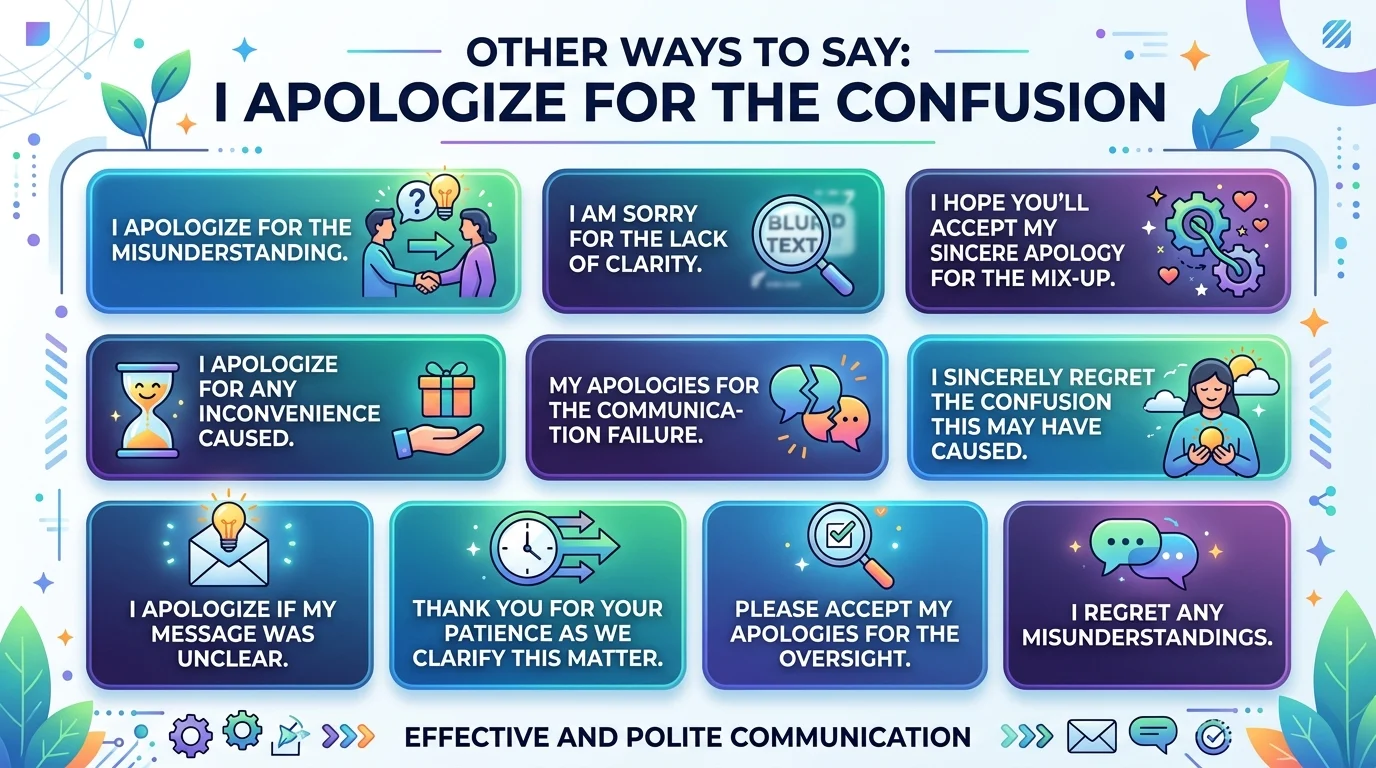
If you are searching for other ways to say I apologize for the confusion, here are quick replacements:
- Sorry for the misunderstanding
- My apologies
- Please accept my apologies
- Sorry for any inconvenience
- I regret the misunderstanding
- Sorry about the mix-up
- I appreciate your patience
- Thank you for your understanding
- I hope this clarifies things
- Let me clarify
- Sorry for the miscommunication
- I regret any confusion caused
- Pardon the confusion
- I take responsibility for the confusion
- Sorry for the unclear information
- Thank you for bearing with us
- I understand the confusion
- Please allow me to clarify
- Sorry for the oversight
- I appreciate your flexibility
Sorry for the Misunderstanding
Meaning
An apology for causing someone to misunderstand something.
Explanation
Among the most common other ways to say I apologize for the confusion, this phrase focuses on misunderstanding rather than confusion.
Grammar Note
Apology phrase.
Example Sentence
Sorry for the misunderstanding regarding the payment details.
Best Use
Emails, workplace communication, customer support.
Worst Use
Legal or highly formal documents.
Tone
Professional, friendly.
Level
Beginner.
Similarity Score
10/10
Replaceability Tip
Use when the problem involves misunderstanding rather than missing information.
My Apologies
Meaning
A concise way to express regret.
Explanation
A shorter alternative often used in professional settings.
Grammar Note
Noun phrase.
Example Sentence
My apologies for the delayed response.
Best Use
Professional emails.
Worst Use
Very casual conversations.
Tone
Professional.
Level
Beginner.
Similarity Score
9/10
Replaceability Tip
Perfect when you want a brief apology.
Please Accept My Apologies
Meaning
A formal request for forgiveness.
Explanation
One of the most formal other ways to say I apologize for the confusion.
Grammar Note
Formal phrase.
Example Sentence
Please accept my apologies for the confusion regarding the schedule.
Best Use
Corporate communication.
Worst Use
Text messages.
Tone
Formal.
Level
Advanced.
Similarity Score
10/10
Replaceability Tip
Use with clients, executives, or official correspondence.
Sorry About the Mix-Up
Meaning
An apology for a mistake or confusion.
Explanation
A friendlier and less formal alternative.
Grammar Note
Informal phrase.
Example Sentence
Sorry about the mix-up with your order.
Best Use
Customer service and casual communication.
Worst Use
Formal reports.
Tone
Friendly.
Level
Beginner.
Similarity Score
8/10
Replaceability Tip
Best when the mistake was minor.
I Regret Any Confusion Caused
Meaning
Expresses regret for creating confusion.
Explanation
Very professional and polished.
Grammar Note
Formal statement.
Example Sentence
I regret any confusion caused by the previous announcement.
Best Use
Corporate communication.
Worst Use
Casual texts.
Tone
Formal.
Level
Advanced.
Similarity Score
10/10
Replaceability Tip
Ideal for announcements and official notices.
Thank You for Your Understanding
Meaning
Shows appreciation rather than focusing on the mistake.
Explanation
A softer alternative to I apologize for the confusion.
Grammar Note
Appreciation phrase.
Example Sentence
Thank you for your understanding as we correct the issue.
Best Use
Customer support.
Worst Use
Situations requiring a direct apology.
Tone
Professional.
Level
Intermediate.
Similarity Score
7/10
Replaceability Tip
Use after already acknowledging the issue.
I Appreciate Your Patience
Meaning
Thanks someone for waiting calmly.
Explanation
Commonly used in business communication.
Grammar Note
Appreciation phrase.
Example Sentence
I appreciate your patience while we resolve this matter.
Best Use
Service updates.
Worst Use
When no delay occurred.
Tone
Professional.
Level
Intermediate.
Similarity Score
6/10
Replaceability Tip
Good when confusion caused delaysother, ways to say i apologize for the confusion.
Let Me Clarify
Meaning
An offer to explain more clearly.
Explanation
Focuses on solving the confusion.
Grammar Note
Verb phrase.
Example Sentence
Let me clarify the process for you.
Best Use
Meetings and emails.
Worst Use
When an apology is necessary.
Tone
Neutral.
Level
Beginner.
Similarity Score
5/10
Replaceability Tip
Use alongside an apology.
Sorry for the Miscommunication
Meaning
Acknowledges poor communication.
Explanation
A direct alternative among other ways to say I apologize for the confusion.
Example Sentence
Sorry for the miscommunication regarding the deadline.other ways to say i apologize for the confusion
Tone
Professional.
Similarity Score
10/10
Pardon the Confusion
Meaning
A polite request for understanding.
Example Sentence
Pardon the confusion while we update our records.other ways to say i apologize for the confusion
Tone
Soft and polite.
Similarity Score
8/10
I Take Responsibility for the Confusion
Meaning
Accepts accountability.
Example Sentence
I take responsibility for the confusion caused by the incorrect data.other ways to say i apologize for the confusion
Tone
Strong and professional.
Similarity Score
10/10
Sorry for the Oversight
Meaning
An apology for forgetting or missing something.other ways to say i apologize for the confusion
Example Sentence
Sorry for the oversight in the report.
Tone
Professional.
Similarity Score
7/10
I Hope This Clarifies Things
Meaning
Indicates that confusion has been resolved.
Example Sentence
I hope this clarifies things moving forward.
Tone
Professional.
Similarity Score
6/10
Thank You for Bearing With Us
Meaning
Appreciates patience during a problem.
Example Sentence
Thank you for bearing with us during this issue.
Tone
Professional.
Similarity Score
5/10
I Understand the Confusion
Meaning
Acknowledges another person’s experience.
Example Sentence
I understand the confusion and would like to explain further.
Tone
Empathetic.
Similarity Score
7/10
Please Allow Me to Clarify
Meaning
A polite offer to explain.
Example Sentence
Please allow me to clarify the details.
Tone
Formal.
Similarity Score
6/10
Mini Dialogue Examples
Formal Dialogue
Manager: There seems to be confusion about the timeline.
Employee: I apologize for the confusion. Let me clarify the updated schedule.
Informal Dialogue
Friend: I thought we were meeting at six.
Friend: Sorry about the mix-up. I meant seven.
Email Example
Subject: Project Update
Dear Team,
I apologize for the confusion regarding the project deadline. The correct due date is Friday. Thank you for your understanding.
Best regards,
Sarah
Mistakes to Avoid
- Using casual apologies in formal emails.
- Overusing “sorry” repeatedly.
- Forgetting to clarify the issue.
- Taking blame for something unrelated.
- Using slang in professional communication.
- Not providing corrected information.
- Sounding defensive after apologizing.
Cultural and Tone Tips
UK English
People often prefer softer apologies and indirect language.
US English
Direct apologies are common and appreciated.
Casual Social English
Short forms such as “Sorry about that” are more natural.
Comparison Table
| Phrase | Tone | Best Context | Professional Level | Example |
|---|---|---|---|---|
| Sorry for the misunderstanding | Professional | High | Sorry for the misunderstanding regarding the report. | |
| My apologies | Formal | Workplace | High | My apologies for the delay. |
| Please accept my apologies | Formal | Corporate | Very High | Please accept my apologies for the confusion. |
| Sorry about the mix-up | Friendly | Casual | Medium | Sorry about the mix-up. |
| I regret any confusion caused | Formal | Business | Very High | I regret any confusion caused. |
| Thank you for your understanding | Professional | Customer service | High | Thank you for your understanding. |
| I appreciate your patience | Professional | Support | High | I appreciate your patience. |
FAQs
Is “I apologize for the confusion” rude?
No. It is considered polite and professional.
Is it okay in emails?
Yes. It is widely used in business emails.
What is the most formal alternative?
Please accept my apologies.
What is the most professional alternative?
I regret any confusion caused.
What is the friendliest alternative?
Sorry about the mix-up.
What should beginners use?
Sorry for the misunderstanding.
Conclusion
Knowing other ways to say I apologize for the confusion helps you communicate with greater confidence and clarity. Different situations require different tones. A workplace email may need a formal apology, while a casual conversation may only require a simple explanation. By learning synonyms for I apologize for the confusion, you can sound more natural, professional, and fluent in English. Practice these alternatives in real conversations, emails, and workplace situations to improve your communication skills and build stronger relationships.